

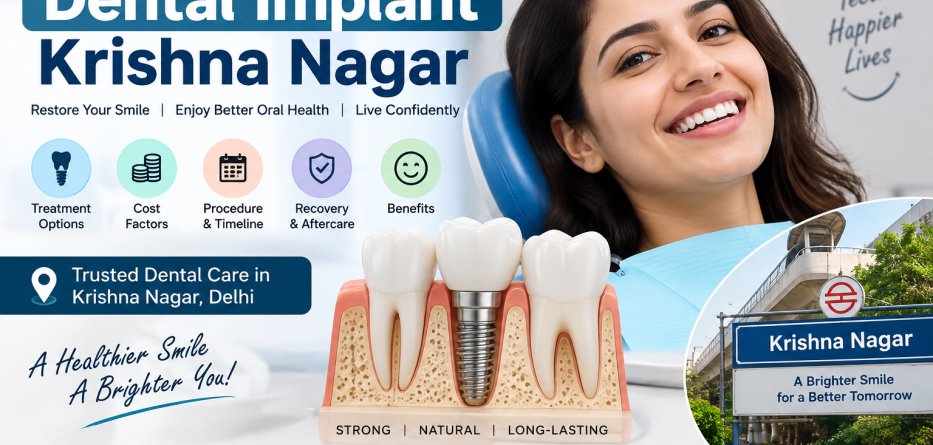
A missing tooth affects more than your smile. It can make chewing uncomfortable, affect your confidence and, over time, contribute to changes in the surrounding teeth and jawbone. If you are searching for Dental Implant Krishna Nagar, you are probably looking for a reliable way to replace a missing tooth without depending only on a removable denture.
Dental implants are artificial tooth roots placed into the jawbone. They can support a crown, bridge or denture. Modern implant treatment is usually planned in several stages, and not every patient needs the same procedure.
The important question is not simply, “How much does an implant cost?” It is whether the treatment is suitable for your mouth, how it will be planned, what type of restoration you need and how the implant will be maintained afterward.
What You’ll Learn
This guide explains:
- What dental implants are
- Who can get dental implants
- Dental implant treatment stages
- Dental implant cost factors in Krishna Nagar
- Pain and recovery
- Bone grafting
- Implant longevity
- Smoking and diabetes
- Implant vs bridge vs denture
- How to choose an implant dentist
- Questions to ask before treatment
- Frequently asked questions
What Is a Dental Implant?
A dental implant is an artificial tooth root placed into the jawbone. After the implant integrates with the bone, a replacement tooth can be attached to it.
A typical implant restoration has three major components:
- Implant fixture – the part placed into the jawbone.
- Abutment – the connector between the implant and restoration.
- Crown – the visible replacement tooth.
For multiple missing teeth, implants may also support a dental bridge or removable denture.
Why do people choose implants?
Depending on the patient’s situation, implants can:
- Replace a missing tooth without relying on neighbouring teeth.
- Provide a fixed tooth replacement.
- Improve chewing ability.
- Support a dental bridge or denture.
- Provide a natural-looking restoration.
- Help preserve the area of the jawbone where the tooth was lost.
However, an implant is not automatically the right solution for every patient. A proper examination is essential.
Visual Recommendation
Type: Dental implant anatomy diagram
Purpose: Explain implant, abutment and crown visually.
Alt Text: Dental implant showing implant fixture abutment and crown
Placement: Immediately after this section.
Dental Implant Treatment in Krishna Nagar: Who Is a Suitable Candidate?
Most adults with one or more missing teeth can potentially be considered for implant treatment, but suitability depends on individual factors.
A dentist will generally assess:
- Jawbone quantity and quality
- Gum health
- Existing infections
- Oral hygiene
- General health
- Smoking or tobacco use
- Diabetes control
- Previous dental treatment
- The position of the missing tooth
X-rays and, when required, 3D imaging help the dental team evaluate the bone and plan implant placement.
What if there isn’t enough bone?
Bone loss can occur after tooth loss. If there is insufficient bone to support an implant, the dentist may recommend bone grafting.
Not every patient needs a bone graft.
If grafting is necessary, treatment may take longer because the graft needs time to heal before or around implant placement. NHS guidance notes that bone grafting can add several months to treatment in some cases.
Dental Implant Procedure: Step-by-Step
Dental implant treatment is usually not a single appointment. The exact sequence depends on the patient’s condition.
1. Initial consultation
The dentist examines your teeth and gums and discusses:
- Missing teeth
- Medical history
- Previous dental procedures
- Your expectations
- Available treatment options
2. Diagnostic imaging
X-rays and, when necessary, 3D imaging are used to assess the jawbone and implant position.
3. Treatment planning
The dentist determines:
- Implant position
- Implant size
- Whether bone grafting is required
- Type of final crown
- Number of implants
- Expected treatment stages
4. Implant placement
The implant is placed into the jawbone under appropriate anaesthesia.
5. Healing and osseointegration
The bone gradually integrates with the implant. This biological process is known as osseointegration.
6. Abutment and crown
After sufficient healing, the restorative stage begins. Impressions or digital scans may be used to create the final replacement tooth.
A hospital dental implant service describes treatment as typically involving assessment, possible bone grafting, implant placement and restorative treatment.
Visual Recommendation
Type: Treatment-flow infographic
Purpose: Show consultation → scan → placement → healing → crown.
Alt Text: Dental implant treatment stages from consultation to final crown
Placement: After the procedure section.
How Much Does a Dental Implant Cost in Krishna Nagar?
There is no single dental implant price that applies to every patient in Krishna Nagar.
The total cost can depend on:
- Number of implants
- Implant brand and system
- Type of crown
- Bone grafting requirements
- Extraction requirements
- Diagnostic scans
- Complexity of the case
- Specialist involvement
- Follow-up requirements
Some online local listings publish implant price ranges. For example, one Delhi dental listing near Krishna Nagar reports dental implants at approximately ₹20,000–₹45,000, but such directory prices should not be treated as a universal market price or a personalised quotation.
Ask what is included in the quotation
Before agreeing to treatment, ask whether the quoted amount includes:
- Consultation
- X-rays/CBCT
- Implant fixture
- Abutment
- Crown
- Extraction
- Bone grafting
- Temporary tooth
- Follow-up visits
A very low headline price may not represent the complete treatment cost.
Visual Recommendation
Type: Cost comparison table
Purpose: Separate basic implant, crown, imaging, extraction and possible grafting costs.
Alt Text: Dental implant cost factors in Krishna Nagar Delhi
Placement: After the pricing section.
