

Missing teeth can affect more than just your smile. They can impact your ability to eat, speak, and maintain good oral health. Fortunately, dental implants offer a long-lasting and natural-looking solution for replacing missing teeth.
Dental implants have become the gold standard in tooth replacement because they function similarly to natural teeth. Unlike dentures or bridges, implants replace both the visible tooth and the root beneath the gums, providing exceptional stability and durability.
But how do dental implants actually work? In this guide, we’ll explain the science behind dental implants, how they are placed, and why they are one of the most successful treatments in modern dentistry.
What Are Dental Implants?
A dental implant is a small titanium post that is surgically inserted into the jawbone to replace the root of a missing tooth. Once the implant integrates with the bone, it serves as a stable foundation for a replacement tooth.
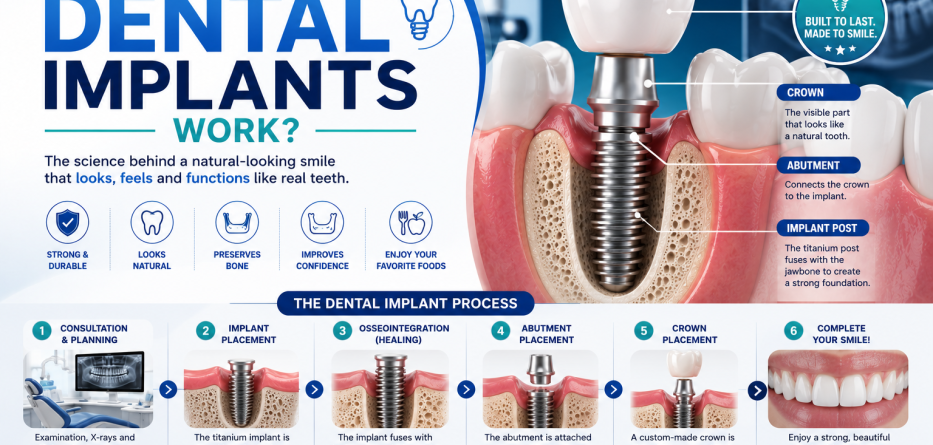
Components of a Dental Implant
A complete dental implant consists of three parts:
1. Implant Post
The titanium screw-like post is placed into the jawbone and acts as an artificial tooth root.
2. Abutment
The abutment is a connector piece that attaches the implant post to the final restoration.
3. Dental Crown
The crown is the visible part of the implant that resembles a natural tooth.
Together, these components create a strong and functional tooth replacement.
How Do Dental Implants Work?
Dental implants work by replacing the missing tooth root and stimulating the jawbone in the same way natural teeth do.
Unlike dentures that sit on top of the gums, implants become part of the jaw through a biological process called osseointegration.
Quick Answer
Dental implants work by surgically placing a titanium implant into the jawbone, where it fuses with the bone and provides a secure foundation for a replacement tooth.
The Step-by-Step Dental Implant Process
Step 1: Consultation and Examination
The process begins with a comprehensive dental evaluation.
Your dentist may use:
- Digital X-rays
- 3D CT scans
- Oral examinations
- Medical history review
This helps determine whether you are a suitable candidate for implants.
Step 2: Treatment Planning
The dentist creates a customized treatment plan based on:
- Bone density
- Gum health
- Number of missing teeth
- Implant location
Advanced digital planning improves precision and long-term success.
Step 3: Implant Placement Surgery
During the procedure, the dentist places the titanium implant into the jawbone.
The surgery is typically performed under local anesthesia and is often less uncomfortable than patients expect.
After placement, the implant remains beneath the gum while healing begins.
Step 4: Osseointegration
Osseointegration is the most important stage of the implant process.
During this phase:
- Bone cells grow around the implant
- The implant fuses with the jawbone
- Stability increases over time
This healing period usually takes between three and six months.
Once completed, the implant becomes firmly anchored within the jaw.
Step 5: Abutment Placement
After successful healing, an abutment is attached to the implant.
The abutment serves as the connection between the implant and the final crown.
In some cases, the abutment may be placed during the initial surgery.
Step 6: Crown Placement
A custom-made dental crown is attached to the abutment.
The crown is carefully designed to match the following:
- Shape
- Size
- Color
- Appearance of surrounding teeth
The result is a natural-looking smile restoration.
Why Titanium Is Used for Dental Implants
Titanium is the most commonly used implant material because it offers unique advantages.
Benefits of Titanium
- Biocompatible with human tissue
- Strong and durable
- Resistant to corrosion
- Supports osseointegration
- Long clinical history of success
The body’s bone cells naturally bond with titanium, making it ideal for dental implants.
How Dental Implants Stay Secure
The stability of dental implants comes from osseointegration.
Unlike removable dentures, implants do not rely on adhesives or support from neighboring teeth.
Instead, the jawbone directly attaches to the implant surface.
This provides:
- Strong chewing power
- Long-term stability
- Improved comfort
- Natural tooth function
Many patients report that implants feel almost identical to natural teeth.
How Dental Implants Help Preserve Oral Health
Dental implants offer several health benefits beyond replacing missing teeth.
Prevent Bone Loss
When a tooth is lost, the jawbone no longer receives stimulation and begins to shrink.
Dental implants help maintain bone density by stimulating the bone during chewing.
Prevent Tooth Shifting
Missing teeth can cause neighboring teeth to move out of position.
Implants help maintain proper alignment.
Improve Bite Function
Implants restore normal chewing ability and allow patients to enjoy a wider variety of foods.
Dental Implants vs Other Tooth Replacement Options
| Feature | Dental Implants | Bridges | Dentures |
|---|---|---|---|
| Replace Tooth Root | Yes | No | No |
| Bone Preservation | Yes | Limited | No |
| Stability | Excellent | Good | Moderate |
| Lifespan | 20+ Years | 5–15 Years | 5–10 Years |
| Natural Feel | Excellent | Good | Moderate |
Because they replace the root as well as the tooth, implants provide advantages that other restorations cannot match.
Who Is a Good Candidate for Dental Implants?
Most healthy adults can be candidates for implants.
Ideal candidates typically have:
- Healthy gums
- Sufficient jawbone density
- Good oral hygiene habits
- Non-smoking lifestyle
- Controlled medical conditions
Even patients with bone loss may qualify after bone grafting procedures.
How Long Do Dental Implants Last?
Dental implants are designed to be a long-term solution.
With proper care:
- Implant posts can last a lifetime
- Crowns often last 10–15 years or longer
- Success rates frequently exceed 95%
Regular maintenance plays a significant role in longevity.
Caring for Dental Implants
Proper maintenance is essential for long-term success.
Daily Care Tips
- Brush twice daily
- Floss around implants
- Use recommended oral hygiene products
- Avoid tobacco use
- Attend regular dental checkups
Implants require care similar to natural teeth.
Frequently Asked Questions
Are dental implants painful?
Most patients experience only mild discomfort after implant placement, which is usually managed with medication.
How long does the implant process take?
The entire process typically takes between three and nine months, depending on healing requirements.
Can dental implants fail?
Implant failure is uncommon but may occur due to infection, smoking, poor oral hygiene, or insufficient bone support.
Do dental implants look natural?
Yes. Modern implant crowns are custom-made to blend seamlessly with surrounding teeth.
Can implants replace multiple teeth?
Yes. Dental implants can support single crowns, bridges, or full-arch restorations.
Conclusion
Understanding how dental implants work can help patients make informed decisions about replacing missing teeth. By replacing the tooth root and integrating with the jawbone, dental implants provide unmatched stability, function, and long-term oral health benefits.
Their ability to mimic natural teeth, preserve bone structure, and restore confidence makes dental implants one of the most effective and reliable tooth replacement solutions available today.
