

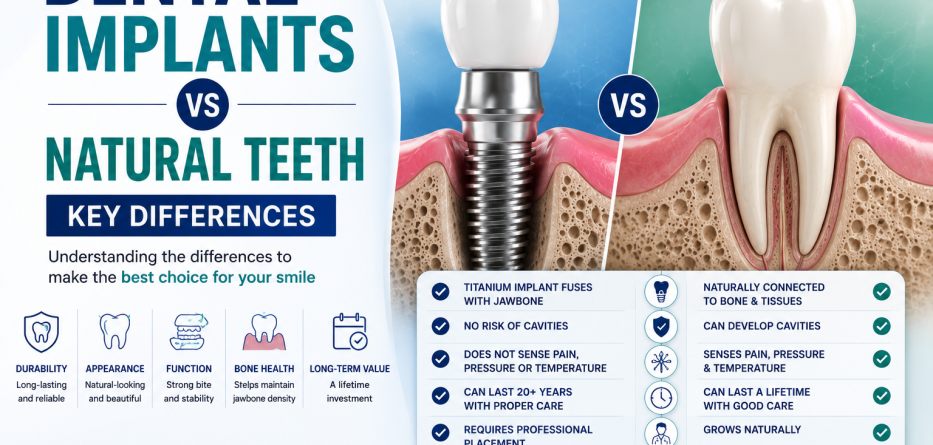
When it comes to replacing missing teeth, dental implants are often considered the closest alternative to natural teeth. Modern dental implant technology has advanced significantly, allowing patients to regain their smile, chewing ability, and confidence. However, despite their remarkable similarities, dental implants and natural teeth are not exactly the same.
Understanding the differences between dental implants and natural teeth can help patients make informed decisions about tooth replacement options. While both serve the same primary function, they differ in structure, sensation, maintenance requirements, and long-term care.
In this guide, we’ll compare dental implants and natural teeth in detail, exploring their similarities, differences, benefits, and limitations.
What Are Natural Teeth?
Natural teeth are living structures that develop within the jawbone and are connected to surrounding tissues through a complex network of nerves, blood vessels, and ligaments.
Each natural tooth consists of:
- Enamel
- Dentin
- Pulp
- Root
- Periodontal ligament
Natural teeth receive nutrients and sensory signals through the pulp and surrounding tissues.
What Are Dental Implants?
Dental implants are artificial tooth replacements designed to mimic the function of natural tooth roots.
A dental implant consists of:
- Titanium implant post
- Abutment
- Custom dental crown
The implant integrates with the jawbone through a biological process called osseointegration, creating a strong and stable foundation.
Quick Comparison: Dental Implants vs Natural Teeth
| Feature | Natural Teeth | Dental Implants |
|---|---|---|
| Living Tissue | Yes | No |
| Blood Supply | Yes | No |
| Nerve Sensation | Yes | Limited |
| Root Structure | Natural Root | Titanium Implant |
| Bone Stimulation | Yes | Yes |
| Risk of Cavities | Yes | No |
| Risk of Gum Disease | Yes | Yes |
| Lifespan | Lifetime with Care | 20+ Years or Lifetime |
| Appearance | Natural | Highly Natural |
| Chewing Ability | Excellent | Excellent |
Appearance: Can Implants Look Like Natural Teeth?
One of the biggest reasons patients choose dental implants is their realistic appearance.
Modern implant crowns are customized to match the following:
- Tooth color
- Shape
- Size
- Alignment
When placed by an experienced dentist, implants are often indistinguishable from surrounding natural teeth.
Winner: Tie
From a cosmetic perspective, high-quality dental implants can closely replicate natural teeth.
Function and Chewing Performance
Natural teeth provide excellent chewing efficiency because they are firmly anchored within the jawbone.
Dental implants offer similar advantages due to osseointegration.
Patients can comfortably eat the following:
- Fruits
- Vegetables
- Meat
- Nuts
- Crunchy foods
Unlike removable dentures, implants do not slip or move during meals.
Winner: Tie
Both options provide excellent chewing performance.
Sensation and Feedback
Natural teeth contain nerves that provide sensory feedback.
This allows people to:
- Detect pressure
- Sense temperature
- Feel texture
- Identify discomfort quickly
Dental implants do not contain nerves.
However, surrounding tissues can still provide limited sensory awareness through a process known as osseoperception.
Winner: Natural Teeth
Natural teeth provide superior sensory feedback and responsiveness.
Strength and Durability
Healthy natural teeth are remarkably strong.
However, they can become damaged by:
- Cavities
- Trauma
- Fractures
- Decay
Dental implants use titanium, one of the strongest materials used in medicine.
Benefits include:
- Corrosion resistance
- Exceptional durability
- Long-term stability
Winner: Dental Implants
Implants are highly resistant to structural damage and decay.
Bone Preservation
Natural tooth roots stimulate the jawbone whenever you chew.
This stimulation helps maintain bone density.
Dental implants are unique because they also stimulate the jawbone after osseointegration.
Other replacement options, such as dentures, cannot provide this benefit.
Winner: Tie
Both natural teeth and implants help preserve jawbone health.
Risk of Tooth Decay
Natural teeth can develop the following:
- Cavities
- Enamel erosion
- Root decay
Dental implants cannot decay because they are made from titanium and ceramic materials.
However, surrounding gum tissue still requires care.
Winner: Dental Implants
Implants are immune to cavities.
Risk of Gum Disease and Infection
Natural teeth are vulnerable to periodontal disease.
Dental implants face similar risks through conditions such as:
- Peri-implant mucositis
- Peri-implantitis
Both require proper oral hygiene and professional maintenance.
Winner: Tie
Healthy gums are essential for both natural teeth and implants.
Longevity and Lifespan
Natural Teeth
With excellent oral care, natural teeth can last a lifetime.
Dental Implants
Dental implants can also last decades and often remain functional for life.
Average implant lifespan:
- Implant post: 20+ years
- Crown: 10–15 years
Winner: Tie
Both can provide lifelong function when properly maintained.
Maintenance Requirements
Natural teeth require the following:
- Brushing
- Flossing
- Regular cleanings
- Cavity prevention
Dental implants require:
- Brushing
- Flossing
- Professional examinations
- Monitoring for peri-implant disease
Maintenance routines are very similar.
Winner: Tie
Neither option is maintenance-free.
Cost Comparison
| Treatment | Initial Cost | Long-Term Value |
| Natural Teeth | Lower | Excellent |
| Dental Implants | Higher | Excellent |
Although implants involve a larger initial investment, their durability often makes them cost-effective over time.
Advantages of Dental Implants
Key Benefits
- Natural appearance
- Strong chewing ability
- No risk of cavities
- Bone preservation
- Long lifespan
- Improved confidence
- Stable and secure fit
Advantages of Natural Teeth
Key Benefits
- Natural sensation
- Built-in nerve feedback
- Self-repair capabilities through biological processes
- No surgical placement required
Whenever possible, preserving healthy natural teeth remains the preferred option in dentistry.
When Are Dental Implants the Better Choice?
Dental implants may be recommended when:
- A tooth is severely damaged
- A tooth cannot be saved
- Multiple teeth are missing
- Tooth extraction is necessary
- Dentures are unstable
For many patients, implants offer the most predictable long-term replacement solution.
Frequently Asked Questions
Are dental implants as strong as natural teeth?
Yes. In many cases, dental implants provide chewing strength comparable to natural teeth.
Do implants feel like real teeth?
Most patients report that implants feel very similar to natural teeth after healing.
Can dental implants get cavities?
No. Dental implants cannot develop cavities, but surrounding gums still require care.
Which lasts longer: implants or natural teeth?
Both can potentially last a lifetime with proper maintenance.
Can implants replace multiple teeth?
Yes. Dental implants can support single crowns, bridges, and full-arch restorations.
Conclusion
When comparing dental implants vs. natural teeth, it’s clear that both offer unique advantages. Natural teeth provide unmatched sensory feedback and biological function, while dental implants excel in durability, stability, and resistance to decay.
Whenever possible, preserving healthy natural teeth remains the ideal choice. However, when tooth loss occurs, dental implants offer the closest replacement available in modern dentistry. Their ability to restore appearance, function, and confidence makes them one of the most successful and trusted solutions for replacing missing teeth.

