
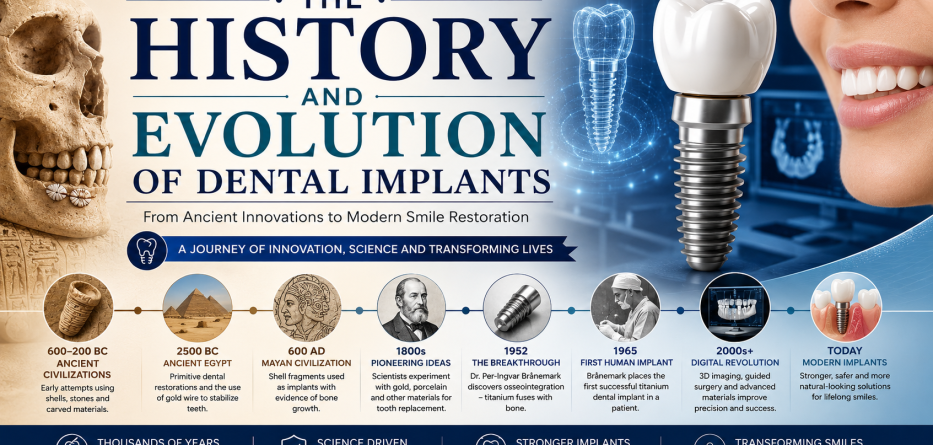
Dental implants are widely regarded as one of the greatest advancements in modern dentistry. Today, they provide a reliable, long-lasting solution for replacing missing teeth, restoring smiles, and improving quality of life. However, the journey of dental implants spans thousands of years and involves fascinating discoveries, innovations, and scientific breakthroughs.
The history and evolution of dental implants reveal how ancient civilizations experimented with tooth replacement and how modern technology transformed those early attempts into one of the most successful procedures in healthcare.
What You’ll Learn
In this article, you’ll discover:
- The origins of dental implants in ancient civilizations
- Early attempts at tooth replacement
- The discovery of osseointegration
- The development of modern dental implant systems
- Key milestones in implant dentistry
- Current innovations shaping the future of dental implants
What Are Dental Implants?
Dental implants are artificial tooth roots, typically made from biocompatible titanium, that are surgically placed into the jawbone to support replacement teeth.
Unlike dentures or bridges, implants fuse directly with the jawbone through a process called osseointegration, creating a strong and stable foundation for crowns, bridges, or dentures.
The Earliest Evidence of Dental Implants
Ancient Civilizations and Tooth Replacement
The desire to replace missing teeth is not a modern concept. Archaeological evidence suggests that ancient civilizations attempted tooth replacement thousands of years ago.
Ancient Egypt (Around 2500 BCE)
Historians have found evidence of primitive dental work in ancient Egyptian remains. Some mummies show signs of teeth being stabilized with gold wire.
While not true dental implants, these procedures demonstrate early efforts to restore oral function and appearance.
The Mayan Civilization (Around 600 CE)
One of the earliest known examples of dental implants comes from the ancient Maya civilization.
Archaeologists discovered a mandible belonging to a young woman with shell fragments placed into the sockets of missing teeth.
Remarkably, studies revealed evidence of bone growth around these shell implants, suggesting a primitive form of osseointegration.
Dental Implant Attempts During the Middle Ages
Throughout the Middle Ages and Renaissance periods, tooth replacement remained challenging.
Materials used included:
- Human teeth
- Animal teeth
- Ivory
- Precious metals
Unfortunately, most procedures failed due to infection, poor sterilization practices, and limited understanding of bone healing.
Dentistry during this era focused primarily on extractions rather than tooth replacement.
The 18th and 19th Century: Scientific Experimentation Begins
The Age of Enlightenment brought significant advances in medicine and surgery.
Researchers began experimenting with various materials for implant placement, including:
- Gold
- Platinum
- Silver
- Porcelain
Challenges Faced
Most implants failed because the body rejected foreign materials or because infections developed after surgery.
Scientists had not yet discovered the biological principles necessary for successful implant integration.
The Breakthrough That Changed Dentistry Forever
The Discovery of Osseointegration
The most significant milestone in the history of dental implants occurred in 1952.
Professor Per-Ingvar Brånemark’s Discovery
Swedish orthopedic surgeon Per-Ingvar Brånemark was studying bone healing in rabbits.
During his research, he inserted titanium chambers into bone tissue. When attempting to remove them, he discovered that the titanium had permanently fused with the bone.
This phenomenon became known as osseointegration.
Why It Was Revolutionary
For the first time, scientists understood that certain materials could biologically integrate with living bone rather than being rejected.
This discovery laid the foundation for modern implant dentistry.
The Birth of Modern Dental Implants
The First Successful Human Dental Implant
In 1965, Brånemark placed the first titanium dental implant into a human patient named Gösta Larsson.
The implant functioned successfully for over 40 years.
This landmark achievement proved that dental implants could serve as a reliable long-term tooth replacement solution.
Major Milestones in Dental Implant Evolution
1970s: Growing Clinical Acceptance
Dental professionals began recognizing the potential of titanium implants.
Advancements included:
- Improved surgical techniques
- Better implant designs
- Standardized treatment protocols
1980s: Global Recognition
The Toronto Conference on Osseointegration in 1982 introduced Brånemark’s research to a global audience.
This event significantly accelerated the adoption of implant dentistry worldwide.
1990s: Enhanced Implant Designs
Manufacturers developed:
- Threaded implants
- Surface-treated implants
- Improved abutment systems
These innovations increased success rates and reduced healing times.
2000s: Digital Dentistry Emerges
The integration of digital technology transformed treatment planning through:
- 3D imaging
- Cone Beam CT scans
- Computer-guided surgery
- CAD/CAM restorations
Dentists could now achieve unprecedented precision.
Modern Dental Implants Today
Today’s implants are safer, stronger, and more predictable than ever before.
Features of Modern Implant Systems
- Biocompatible titanium alloys
- Zirconia implant options
- Digital treatment planning
- Immediate load implants
- Minimally invasive procedures
Success Rates
Modern dental implants achieve success rates exceeding 95% in healthy patients.
Many implants last 20 years or longer with proper care.
The Role of Technology in Implant Evolution
Digital Implant Planning
Modern dentists use advanced software to create highly accurate treatment plans.
Benefits include:
- Greater precision
- Reduced surgical risks
- Faster recovery
- Improved patient outcomes
Guided Implant Surgery
Computer-generated surgical guides help dentists place implants with exceptional accuracy.
This technology improves predictability and patient comfort.
Future Trends in Dental Implant Technology
The future of implant dentistry looks promising.
Emerging Innovations
1. 3D Printed Dental Implants
Customized implants may soon be produced specifically for individual patients.
2. Smart Dental Implants
Researchers are developing implants capable of monitoring oral health conditions in real time.
3. Regenerative Dentistry
Stem cell therapies may eventually enable patients to regenerate damaged tissues naturally.
4. Advanced Biomaterials
Future implants may use new materials that promote even faster healing and stronger integration.
Timeline of Dental Implant Evolution
| Year | Milestone |
|---|---|
| 2500 BCE | Early Egyptian dental restorations |
| 600 CE | Mayan shell implants discovered |
| 1700s | Experiments with gold and ivory |
| 1952 | Discovery of osseointegration |
| 1965 | First successful human implant |
| 1982 | Toronto Conference promotes implant dentistry |
| 1990s | Advanced implant designs introduced |
| 2000s | Digital implant planning emerges |
| Today | Highly successful modern implant systems |
Why Dental Implants Became the Gold Standard
Dental implants became the preferred tooth replacement solution because they:
- Preserve jawbone structure
- Mimic natural tooth roots
- Improve chewing efficiency
- Enhance appearance
- Provide long-term durability
- Offer exceptional success rates
No other tooth replacement option delivers the same combination of function, aesthetics, and longevity.
Conclusion
The history and evolution of dental implants showcase one of the most remarkable journeys in healthcare innovation. From ancient Mayan shell implants to sophisticated titanium and zirconia systems, dental implant technology has transformed the way missing teeth are treated.
Thanks to groundbreaking discoveries like osseointegration and advances in digital dentistry, modern dental implants now offer predictable, long-lasting results that improve both oral health and quality of life. As technology continues to evolve, the future of implant dentistry promises even greater precision, comfort, and success for patients worldwide.
