

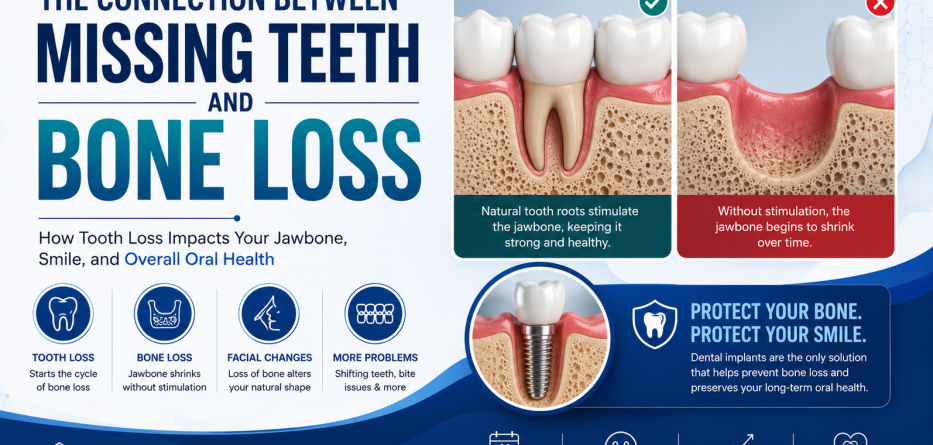
Many people view tooth loss as primarily a cosmetic concern. While missing teeth can certainly affect the appearance of your smile, the consequences go much deeper. One of the most significant yet often overlooked effects of tooth loss is jawbone deterioration.
When a tooth is lost, the underlying bone no longer receives the stimulation it needs to maintain its strength and density. Over time, this can lead to bone loss, changes in facial structure, shifting teeth, and additional oral health complications.
Understanding the connection between missing teeth and bone loss is essential for protecting your long-term oral health. In this article, we’ll explore why bone loss occurs, how it affects your smile, and what treatment options can help preserve your jawbone.
What Happens After You Lose a Tooth?
A natural tooth does more than help you chew and speak. The tooth root continuously stimulates the jawbone whenever you bite or chew.
This stimulation signals the body to maintain healthy bone tissue.
When a tooth is lost:
- The tooth root is no longer present.
- The jawbone receives less stimulation.
- Bone cells begin to break down.
- Bone volume gradually decreases.
This process is known as bone resorption.
Quick Definition
Bone resorption is the natural process in which the jawbone begins to shrink after a tooth is lost due to a lack of stimulation from the tooth root.
Why Does Tooth Loss Cause Bone Loss?
The jawbone is a living tissue that constantly remodels itself based on use.
Just as muscles weaken when they are not exercised, the jawbone shrinks when it no longer supports a tooth.
The Process of Bone Resorption
- Tooth is lost or extracted.
- Tooth root no longer stimulates the bone.
- Bone cells begin breaking down unused bone tissue.
- Jawbone gradually loses volume and density.
- Facial structure may begin to change.
Research shows that significant bone loss can occur within the first year after tooth loss.
How Quickly Does Bone Loss Occur?
Bone loss begins surprisingly soon after tooth extraction.
Typical Timeline
| Time After Tooth Loss | Bone Changes |
|---|---|
| First 3 Months | Initial bone shrinkage begins |
| 6 Months | Noticeable reduction in bone volume |
| 12 Months | Significant bone loss may occur |
| Several Years | Progressive jawbone deterioration |
The longer a missing tooth remains untreated, the greater the amount of bone that may be lost.
Effects of Bone Loss on Oral Health
1. Shifting of Surrounding Teeth
When bone support decreases, neighboring teeth may begin moving into the empty space.
This can lead to:
- Bite problems
- Crowding
- Misalignment
- Increased wear on teeth
2. Facial Changes and Premature Aging
Jawbone loss affects facial support.
As bone volume decreases, patients may experience the following:
- Sunken cheeks
- Wrinkled appearance
- Reduced lip support
- Facial collapse
Many people appear older than their actual age due to advanced bone loss.
3. Difficulty Chewing
Bone deterioration can affect bite strength and stability.
Patients often experience:
- Reduced chewing efficiency
- Difficulty eating certain foods
- Uneven bite pressure
This may impact overall nutrition and quality of life.
4. Increased Risk of Additional Tooth Loss
Bone supports the surrounding teeth.
As bone deteriorates,
- Teeth become less stable
- Gum disease risk increases
- Additional tooth loss becomes more likely
This can create a cycle of ongoing oral health problems.
Which Teeth Are Most Likely to Cause Bone Loss?
Any missing tooth can contribute to bone resorption.
However, bone loss is especially common after losing the following:
- Molars
- Premolars
- Multiple adjacent teeth
- Entire dental arches
The greater the number of missing teeth, the greater the risk of severe bone loss.
Can Dentures Prevent Bone Loss?
Many patients assume dentures solve the problem.
While dentures replace the visible portion of missing teeth, they do not replace the tooth roots.
As a result:
- Bone stimulation remains absent.
- Bone resorption continues.
- Jawbone volume gradually decreases.
Over time, dentures may become loose as the jawbone changes shape.
Why Dental Implants Are Different
Dental implants are currently the only tooth replacement solution that helps preserve jawbone health.
How Implants Prevent Bone Loss
A titanium implant is placed into the jawbone, functioning similarly to a natural tooth root.
Benefits include:
- Bone stimulation
- Bone preservation
- Improved stability
- Long-term jawbone support
The implant integrates with the bone through a process called osseointegration.
Dental Implants vs Other Tooth Replacement Options
| Feature | Dental Implants | Bridges | Dentures |
| Replaces Tooth Root | Yes | No | No |
| Prevents Bone Loss | Yes | Limited | No |
| Long-Term Stability | Excellent | Good | Moderate |
| Preserves Facial Structure | Yes | Limited | No |
This is one reason dental implants are considered the gold standard for replacing missing teeth.
Risk Factors That Accelerate Bone Loss
Several factors can increase the rate of bone resorption.
Common Risk Factors
- Untreated tooth loss
- Periodontal disease
- Smoking
- Osteoporosis
- Poor oral hygiene
- Multiple missing teeth
- Trauma to the jaw
Addressing these factors early can help protect bone health.
Can Bone Loss Be Reversed?
In some cases, lost bone can be rebuilt through specialized procedures.
Bone Grafting
Bone grafting involves adding bone material to areas with insufficient volume.
Benefits include:
- Increased bone density
- Improved implant support
- Better facial structure
- Enhanced oral function
Bone grafting is often performed before dental implant placement.
How to Prevent Bone Loss After Losing a Tooth
If you lose a tooth, early treatment is critical.
Prevention Tips
- Replace missing teeth promptly.
- Maintain excellent oral hygiene.
- Attend regular dental checkups.
- Avoid smoking.
- Consider dental implants when appropriate.
- Treat gum disease early.
- Follow your dentist’s recommendations.
The sooner treatment begins, the easier it is to preserve healthy bone.
Warning Signs of Jawbone Loss
Bone loss often develops gradually.
Possible signs include:
- Loose teeth
- Receding gums
- Changes in facial appearance
- Poor denture fit
- Difficulty chewing
- Bite changes
Regular dental examinations can help identify bone loss before symptoms become severe.
Frequently Asked Questions
Does every missing tooth cause bone loss?
Yes. Any missing tooth can lead to bone resorption because the jawbone loses stimulation from the tooth root.
How much bone loss occurs after tooth extraction?
A significant amount of bone loss may occur within the first year following tooth loss.
Can dentures stop bone loss?
No. Dentures replace missing teeth visually but do not stimulate the jawbone.
Do dental implants prevent bone loss?
Yes. Dental implants mimic natural tooth roots and help maintain bone density.
Is bone grafting always necessary?
Not always. The need for bone grafting depends on the amount of existing bone and treatment goals.
Conclusion
The connection between missing teeth and bone loss is one of the most important aspects of oral health that many patients overlook. Without the stimulation provided by natural tooth roots, the jawbone begins to shrink, leading to changes in facial appearance, bite problems, reduced chewing ability, and increased risk of future tooth loss.
Fortunately, early intervention can help prevent many of these complications. Replacing missing teeth promptly—especially with dental implants—can preserve bone health, maintain facial structure, and support long-term oral function. If you’ve lost a tooth, consulting a dental professional as soon as possible can help protect both your smile and your jawbone for years to come.
