
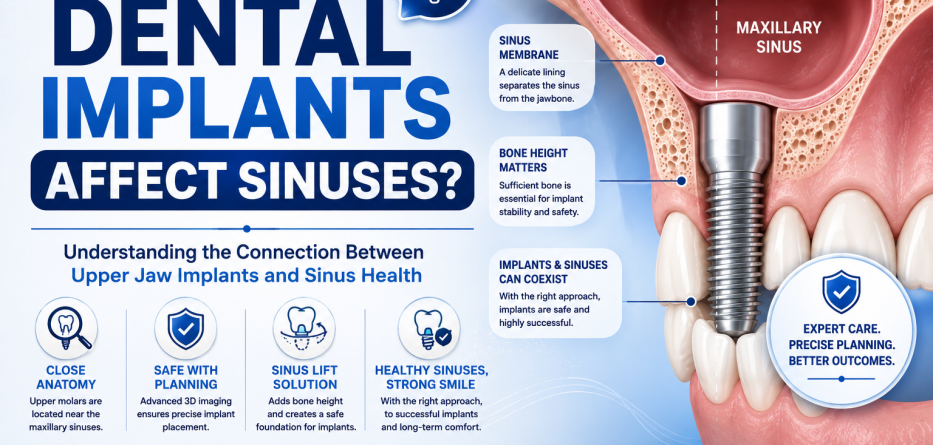
Dental implants are one of the most successful and reliable solutions for replacing missing teeth. However, patients considering implants in the upper jaw often have an important question: Can dental implants affect the sinuses?
The answer is yes—but not necessarily in a negative way. Because the roots of the upper back teeth are located close to the maxillary sinuses, implant placement in this area requires careful planning. Modern dental technology and advanced imaging techniques allow dentists to place implants safely while minimizing sinus-related complications.
In this article, we’ll explain how dental implants and sinuses are connected, potential risks, symptoms to watch for, and how dentists prevent sinus complications during treatment.
What Are the Maxillary Sinuses?
The maxillary sinuses are air-filled spaces located behind your cheeks and above your upper teeth.
These sinuses:
- Help humidify inhaled air
- Reduce skull weight
- Contribute to voice resonance
- Support respiratory function
The roots of the upper molars and premolars often sit very close to the sinus floor, which is why dental implant planning is especially important in the upper jaw.
Can Dental Implants Affect Sinuses?
Quick Answer
Yes, dental implants placed in the upper back jaw can potentially affect the sinuses if there is insufficient bone between the implant site and the sinus cavity. However, modern treatment planning makes sinus complications relatively uncommon.
Most patients undergo implant treatment without experiencing any sinus-related problems.
Why Are Sinuses Important During Dental Implant Placement?
After a tooth is lost, the jawbone gradually shrinks due to lack of stimulation.
In the upper jaw, this bone loss can cause:
- Reduced bone height
- Expansion of the sinus cavity
- Limited space for implant placement
As a result, the sinus floor may sit closer to the area where the implant needs to be placed.
How Can Dental Implants Affect the Sinus Cavity?
Implant Extending Into the Sinus
In rare cases, an implant may protrude into the sinus cavity if insufficient bone is available.
Potential consequences include the following:
- Sinus irritation
- Chronic sinus discomfort
- Inflammation
- Increased infection risk
Proper planning helps prevent this issue.
Sinus Membrane Perforation
The sinus membrane is a thin lining inside the sinus cavity.
During implant placement or sinus lift procedures, accidental perforation may occur.
Most minor perforations heal successfully when properly managed by experienced clinicians.
Sinus Infections
Although uncommon, sinus infections can develop following implant treatment if bacteria enter the sinus cavity.
Possible symptoms include:
- Facial pressure
- Nasal congestion
- Persistent sinus pain
- Headaches
- Post-nasal drip
Prompt treatment usually resolves these issues.
What Is a Sinus Lift Procedure?
When insufficient bone exists in the upper jaw, dentists may recommend a sinus lift.
What Is a Sinus Lift?
A sinus lift is a bone augmentation procedure that gently raises the sinus membrane and places bone graft material beneath it.
This creates additional bone volume for implant placement.
Benefits of a Sinus Lift
- Increases bone height
- Improves implant stability
- Reduces complications
- Expands treatment options
Sinus lifts are routinely performed and have high success rates.
Signs of Sinus Problems After Dental Implants
Most patients heal without complications. However, you should contact your dentist if you experience:
Common Symptoms
- Persistent sinus pressure
- Nasal congestion lasting several weeks
- Facial pain
- Headaches
- Unusual drainage from the nose
- Bad taste in the mouth
- Implant mobility
Early evaluation helps prevent more serious complications.
How Dentists Prevent Sinus Complications
Modern implant dentistry relies on advanced diagnostic technology.
CBCT (Cone Beam CT) Scans
These 3D scans allow dentists to evaluate the following:
- Bone density
- Bone height
- Sinus anatomy
- Nerve locations
Accurate imaging greatly improves treatment safety.
Digital Treatment Planning
Computer-guided planning helps determine:
- Ideal implant position
- Implant length
- Implant angle
- Available bone volume
This precision reduces the risk of sinus involvement.
Bone Grafting Procedures
If bone loss has occurred, grafting procedures can create sufficient support before implant placement.
Benefits include:
- Better stability
- Improved implant success
- Reduced sinus complications
Are Dental Implants Safe Near the Sinuses?
Yes.
When performed by experienced implant dentists using modern technology, dental implants near the sinus cavity are generally very safe.
Research consistently shows:
- High implant success rates
- Low complication rates
- Predictable outcomes
Most patients never experience sinus-related issues after treatment.
Who Is at Greater Risk of Sinus Complications?
Certain factors may increase risk.
Bone Loss
Long-term missing teeth often result in significant bone resorption.
Chronic Sinus Conditions
Patients with:
- Chronic sinusitis
- Nasal polyps
- Recurrent infections
may require additional evaluation.
Smoking
Smoking can impair healing and increase infection risk.
Previous Sinus Surgery
Past sinus procedures may alter anatomy and require specialized treatment planning.
Dental Implants vs Sinus Concerns: Benefits Still Outweigh Risks
Even when sinus augmentation is required, dental implants continue to offer substantial advantages.
Benefits Include
- Natural appearance
- Improved chewing function
- Bone preservation
- Long-term durability
- Enhanced confidence
For most patients, the benefits far outweigh the small risk of sinus complications.
Frequently Asked Questions
Can dental implants cause sinus infections?
In rare cases, implants may contribute to sinus infections if complications occur, but proper planning significantly reduces this risk.
What is a sinus lift?
A sinus lift is a procedure that increases bone volume in the upper jaw by elevating the sinus membrane and adding bone graft material.
Are upper jaw implants riskier?
Upper jaw implants may require additional planning because of their proximity to the sinus cavity, but they remain highly successful.
How do I know if my implant is affecting my sinus?
Symptoms may include sinus pressure, congestion, facial pain, headaches, or unusual drainage. Contact your dentist if these occur.
Can implants be placed without a sinus lift?
Yes. Many patients have sufficient bone and do not require sinus augmentation.
Conclusion
So, can dental implants affect sinuses?
Yes, because the upper back teeth are located close to the maxillary sinus cavity. However, thanks to advanced imaging, digital planning, and modern surgical techniques, sinus-related complications are uncommon and highly manageable.
For patients with bone loss, procedures such as sinus lifts and bone grafting can create a safe foundation for successful implant placement. When performed by an experienced implant dentist, dental implants remain one of the safest and most effective solutions for replacing missing teeth—even in areas close to the sinuses.
If you’re considering upper jaw dental implants, a comprehensive evaluation can determine the safest and most effective treatment plan for your unique anatomy.
