
Missing teeth can affect much more than your appearance. They can impact your ability to chew, speak clearly, maintain proper oral health, and feel confident about your smile. Whether you’ve lost a single tooth or multiple teeth due to injury, decay, gum disease, or aging, replacing missing teeth is important for both your oral health and overall well-being.
Fortunately, modern dentistry offers several effective solutions to restore your smile. From dental implants and bridges to partial and complete dentures, today’s tooth replacement options are more advanced, comfortable, and natural-looking than ever before.
In this guide, we’ll explore the most common missing teeth replacement options, their benefits, drawbacks, costs, and how to determine which solution may be best for your needs.
Why Replacing Missing Teeth Is Important
Many people assume a missing tooth is only a cosmetic issue. However, untreated tooth loss can lead to serious oral health problems.
Consequences of Missing Teeth
- Difficulty chewing food properly
- Speech problems
- Shifting of surrounding teeth
- Bone loss in the jaw
- Changes in facial appearance
- Increased risk of gum disease
- Bite misalignment
Replacing missing teeth helps preserve oral function and prevent these complications.
Common Missing Teeth Replacement Options
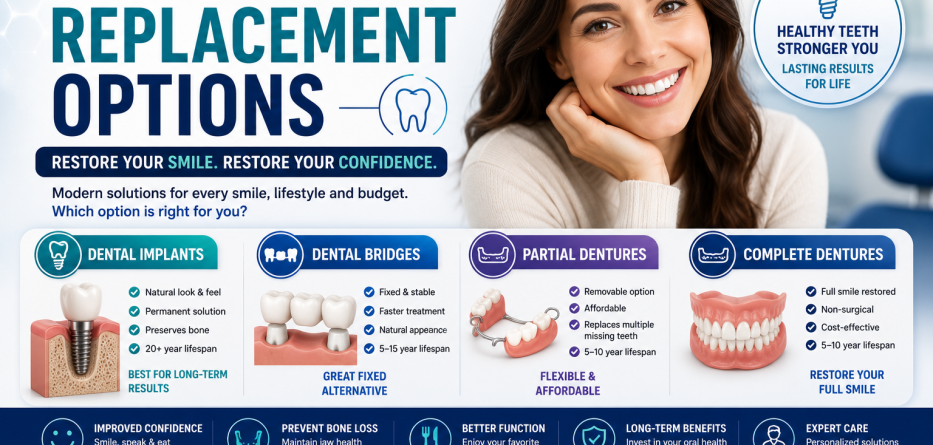
Modern dentistry offers four primary tooth replacement solutions:
- Dental Implants
- Dental Bridges
- Partial Dentures
- Complete Dentures
Each option has unique advantages depending on the patient’s needs, budget, and oral health condition.
1. Dental Implants
What Are Dental Implants?
Dental implants are titanium posts surgically placed into the jawbone to replace missing tooth roots. Once healed, they support a custom crown, bridge, or denture.
Benefits of Dental Implants
- Natural appearance
- Exceptional stability
- Long-lasting results
- Preservation of jawbone
- No impact on neighboring teeth
- Improved chewing ability
Potential Drawbacks
- Higher upfront cost
- Requires surgery
- Longer treatment timeline
Ideal For
- Single missing tooth
- Multiple missing teeth
- Full-mouth restoration
Average Lifespan
20+ years, often a lifetime with proper care.
2. Dental Bridges
What Is a Dental Bridge?
A dental bridge replaces one or more missing teeth by anchoring an artificial tooth to neighboring teeth.
Benefits of Dental Bridges
- Faster treatment
- Lower initial cost than implants
- Fixed and non-removable
- Natural appearance
Potential Drawbacks
- Requires modification of healthy adjacent teeth
- Does not prevent bone loss
- Shorter lifespan than implants
Ideal For
Patients who prefer a fixed restoration but are not candidates for implants.
Average Lifespan
5–15 years.
3. Partial Dentures
What Are Partial Dentures?
Partial dentures are removable appliances designed to replace several missing teeth while preserving remaining natural teeth.
Benefits
- Affordable option
- Non-surgical treatment
- Quick fabrication
- Easy replacement
Potential Drawbacks
- Less stability
- May affect speech initially
- Requires daily removal and cleaning
Ideal For
Patients missing multiple teeth who want an economical solution.
Average Lifespan
5–10 years.
4. Complete Dentures
What Are Full Dentures?
Complete dentures replace all teeth in the upper jaw, lower jaw, or both.
Benefits
- Restores complete smile
- Most affordable full-arch solution
- Non-invasive treatment
Potential Drawbacks
- May slip while eating or speaking
- Does not prevent bone loss
- Requires periodic adjustments
Ideal For
Patients missing all natural teeth.
Average Lifespan
5–10 years.
Dental Implants vs Bridges vs Dentures
| Feature | Dental Implants | Dental Bridges | Dentures |
|---|---|---|---|
| Appearance | Excellent | Excellent | Good |
| Stability | Excellent | Good | Moderate |
| Bone Preservation | Yes | No | No |
| Longevity | 20+ Years | 5–15 Years | 5–10 Years |
| Maintenance | Similar to Natural Teeth | Moderate | Requires Removal |
| Cost | Higher | Moderate | Lower |
Dental implants are often considered the gold standard due to their ability to preserve bone and provide long-term stability.
Single Tooth Replacement Options
If you’re missing only one tooth, common options include:
Dental Implant
Most durable and natural-looking solution.
Traditional Bridge
Can replace one tooth without surgery.
Removable Partial Denture
Most affordable but less stable option.
For long-term oral health, many dentists recommend dental implants whenever possible.
Multiple Missing Teeth Replacement Options
Patients missing several teeth may benefit from:
- Implant-supported bridges
- Partial dentures
- Multiple individual implants
The best solution depends on bone health, budget, and treatment goals.
Full Mouth Teeth Replacement Options
Patients missing all teeth have several options.
Traditional Dentures
Affordable and widely used.
Implant-Supported Dentures
Provide improved stability and comfort.
Full Arch Dental Implants
Often known as All-on-4 or All-on-6 treatment.
Benefits include:
- Fixed restoration
- Better chewing ability
- Bone preservation
- Natural appearance
Factors to Consider When Choosing a Tooth Replacement Option
Oral Health Condition
Healthy gums and adequate bone support may expand treatment options.
Budget
Costs vary significantly between implants, bridges, and dentures.
Longevity
Some solutions require more frequent replacement.
Comfort
Fixed restorations generally provide greater comfort than removable appliances.
Lifestyle
Patients seeking maximum convenience often prefer implant-supported solutions.
Which Tooth Replacement Option Is Best?
There is no one-size-fits-all answer.
Dental Implants
Best for long-term durability, function, and bone preservation.
Bridges
Good option when implants are not suitable.
Partial Dentures
Affordable choice for replacing multiple teeth.
Complete Dentures
Effective solution for complete tooth loss.
A comprehensive dental evaluation can help determine the most suitable treatment plan.
Frequently Asked Questions
What is the best replacement for missing teeth?
Dental implants are often considered the best long-term solution because they provide stability, preserve bone, and function like natural teeth.
Are dental implants worth the cost?
Many patients find implants worthwhile due to their longevity and oral health benefits.
What is the cheapest way to replace missing teeth?
Removable partial dentures and complete dentures are generally the most affordable options.
Can I replace all my teeth with implants?
Yes. Full-mouth implant solutions such as All-on-4 can replace an entire arch of teeth.
What happens if I don’t replace a missing tooth?
Bone loss, shifting teeth, bite problems, and gum issues may develop over time.
Conclusion
Missing teeth can significantly affect your oral health, appearance, and quality of life. Fortunately, modern dentistry offers several effective missing teeth replacement options, including dental implants, bridges, partial dentures, and complete dentures.
Each solution has its own benefits, limitations, and ideal applications. While dental implants are often considered the most advanced and long-lasting option, the right choice ultimately depends on your oral health, lifestyle, and budget.
Consulting with an experienced dental professional is the best way to determine which tooth replacement option can restore your smile and confidence for years to come.
