Introduction
If you’re looking to improve the appearance of your teeth, veneers are one of the most popular cosmetic dentistry treatments available today. Veneers can transform stained, chipped, uneven, or slightly misaligned teeth into a beautiful, confident smile. However, one of the biggest decisions patients face is choosing between porcelain veneers and composite veneers.
While both options can enhance your smile, they differ significantly in terms of durability, appearance, cost, maintenance, and longevity. Understanding these differences can help you make an informed decision based on your goals, budget, and lifestyle.
In this guide, we’ll compare porcelain veneers vs. composite veneers, explore their pros and cons, and help you determine which option may be best for you.
What Are Dental Veneers?
Dental veneers are thin shells that cover the front surface of teeth to improve their appearance.
Veneers can address:
- Tooth discoloration
- Chipped teeth
- Small gaps
- Uneven tooth shapes
- Minor alignment issues
- Worn enamel
The two most common types are the following:
- Porcelain Veneers
- Composite Veneers
Both provide cosmetic improvements, but they differ in material and performance.
What Are Porcelain Veneers?
Porcelain veneers are custom-made shells crafted in a dental laboratory from high-quality ceramic materials.
The veneers are bonded permanently to the front of the teeth.
Key Features
- Highly natural appearance
- Exceptional stain resistance
- Long-lasting durability
- Custom-crafted for each patient
Porcelain veneers are often considered the premium cosmetic dentistry option.
What Are Composite Veneers?
Composite veneers are made from tooth-colored composite resin, similar to the material used in dental bonding.
The dentist applies and sculpts the material directly onto the teeth during treatment.
Key Features
- More affordable
- Faster treatment
- Minimally invasive
- Easier repairs
Composite veneers offer an attractive solution for patients seeking cosmetic improvements on a budget.
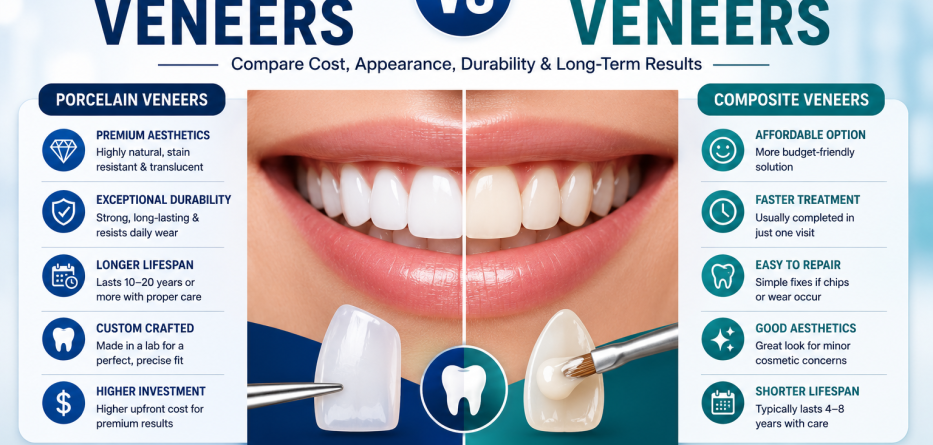
Porcelain Veneers vs Composite Veneers: Side-by-Side Comparison
| Feature | Porcelain Veneers | Composite Veneers |
|---|---|---|
| Appearance | Excellent | Very Good |
| Durability | Excellent | Moderate |
| Lifespan | 10–20 Years | 4–8 Years |
| Stain Resistance | High | Moderate |
| Cost | Higher | Lower |
| Treatment Time | 2–3 Visits | Often 1 Visit |
| Repairability | More Difficult | Easier |
| Strength | Excellent | Good |
| Natural Light Reflection | Superior | Good |
Appearance: Which Looks More Natural?
One of the biggest advantages of porcelain veneers is their ability to mimic natural tooth enamel.
Porcelain Veneers
Benefits include:
- Superior translucency
- Natural light reflection
- Customized shading
- Highly realistic results
Many cosmetic dentists consider porcelain the gold standard for smile makeovers.
Composite Veneers
Composite veneers can also look attractive but may not achieve the same level of realism as porcelain.
They are ideal for:
- Minor cosmetic corrections
- Budget-conscious patients
- Temporary smile enhancements
Winner: Porcelain Veneers
For the most natural-looking smile, porcelain veneers typically provide better aesthetic results.
Durability and Strength
Porcelain Veneers
Porcelain is highly durable and resistant to everyday wear.
With proper care, porcelain veneers often last
- 10 to 20 years
- Sometimes longer
Composite Veneers
Composite resin is softer than porcelain and more prone to the following:
- Chipping
- Wear
- Surface staining
Average lifespan:
- 4 to 8 years
Winner: Porcelain Veneers
Porcelain generally offers superior long-term durability.
Stain Resistance
Coffee, tea, wine, and tobacco can affect cosmetic dental treatments over time.
Porcelain Veneers
Porcelain is highly resistant to staining.
Patients often maintain bright smiles for many years.
Composite Veneers
Composite resin is more porous and can absorb stains gradually.
Regular polishing may be necessary.
Winner: Porcelain Veneers
Porcelain provides significantly better stain resistance.
Cost Comparison
Cost is often a deciding factor for many patients.
Porcelain Veneers
Higher upfront investment due to:
- Custom laboratory fabrication
- Premium materials
- Advanced customization
Composite Veneers
Typically more affordable because
- Less laboratory work
- Faster treatment process
- Lower material costs
Winner: Composite Veneers
For budget-conscious patients, composite veneers offer a more economical solution.
Treatment Process
Porcelain Veneers Procedure
- Consultation and smile design
- Tooth preparation
- Digital impressions
- Laboratory fabrication
- Final bonding
Treatment usually requires multiple appointments.
Composite Veneers Procedure
- Consultation
- Direct application of composite resin
- Sculpting and shaping
- Polishing
Many cases can be completed in a single visit.
Winner: Composite Veneers
Composite veneers offer faster treatment.
Maintenance Requirements
Both types require:
- Daily brushing
- Daily flossing
- Routine dental visits
- Avoiding excessive force
Porcelain Veneers
Require minimal maintenance and retain their appearance longer.
Composite Veneers
May need:
- Periodic polishing
- Repairs
- Earlier replacement
Winner: Porcelain Veneers
Less maintenance over time.
Repairability
Porcelain Veneers
If damaged, replacement is often necessary.
Composite Veneers
Small chips and defects can frequently be repaired chairside.
Winner: Composite Veneers
Repairs are generally simpler and less expensive.
Who Should Choose Porcelain Veneers?
Porcelain veneers may be ideal if you:
- Want the most natural appearance
- Desire long-term results
- Have significant cosmetic concerns
- Prioritize stain resistance
- Are willing to invest more upfront
Who Should Choose Composite Veneers?
Composite veneers may be ideal if you:
- Have a limited budget
- Need quick cosmetic improvements
- Want a minimally invasive treatment
- Need minor smile corrections
- Prefer easier future repairs
Pros and Cons of Porcelain Veneers
Advantages
- Highly aesthetic
- Long lifespan
- Excellent stain resistance
- Superior durability
- Natural appearance
Disadvantages
- Higher cost
- Multiple appointments
- Difficult repairs
- Irreversible tooth preparation
Pros and Cons of Composite Veneers
Advantages
- More affordable
- Faster treatment
- Easier repairs
- Conservative approach
Disadvantages
- Shorter lifespan
- Greater stain susceptibility
- Less natural appearance
- More maintenance required
Frequently Asked Questions
Are porcelain veneers better than composite veneers?
Porcelain veneers generally provide better aesthetics, durability, and stain resistance, while composite veneers offer lower costs and faster treatment.
How long do porcelain veneers last?
Most porcelain veneers last between 10 and 20 years with proper care.
How long do composite veneers last?
Composite veneers typically last between 4 and 8 years.
Which veneers are more affordable?
Composite veneers are usually significantly less expensive than porcelain veneers.
Can composite veneers be repaired?
Yes. Composite veneers can often be repaired quickly and easily.
Do porcelain veneers stain?
Porcelain veneers are highly stain-resistant and maintain their appearance for many years.
Conclusion
When comparing porcelain veneers vs. composite veneers, there is no one-size-fits-all answer. The best choice depends on your cosmetic goals, budget, lifestyle, and long-term expectations.
If you want the most natural appearance, superior durability, and long-lasting results, porcelain veneers are often the preferred option. If affordability, convenience, and quick treatment are your priorities, composite veneers may be an excellent choice.
A consultation with an experienced cosmetic dentist can help determine which veneer option is best suited to your unique smile and aesthetic goals.