

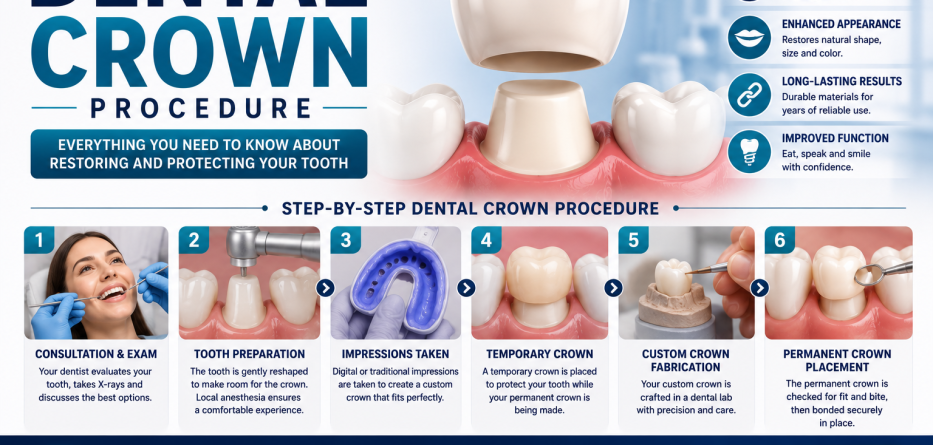
A damaged, weakened, or severely decayed tooth can affect your ability to eat, speak, and smile confidently. Fortunately, modern dentistry offers an effective solution: dental crowns. Dental crowns are one of the most common restorative dental treatments used to protect and strengthen compromised teeth while restoring their appearance and function.
If your dentist has recommended a dental crown, you may be wondering what the procedure involves, how long it takes, and whether it is painful. Understanding the dental crown procedure can help you feel more comfortable and prepared for treatment.
In this guide, we’ll explain the dental crown procedure step by step, discuss the different types of crowns available, and answer common patient questions.
What Is a Dental Crown?
A dental crown is a custom-made cap that completely covers a damaged or weakened tooth. It restores the tooth’s shape, size, strength, and appearance.
Dental crowns may be recommended for:
- Severely decayed teeth
- Cracked or fractured teeth
- Root canal-treated teeth
- Worn-down teeth
- Large dental fillings
- Cosmetic smile improvements
- Dental implant restorations
Once placed, a crown functions much like a natural tooth.
Why Might You Need a Dental Crown?
Your dentist may recommend a crown when a tooth cannot be adequately restored with a filling alone.
Common Reasons for Dental Crowns
- Protect a weakened tooth
- Restore a broken tooth
- Improve tooth appearance
- Cover a dental implant
- Support a dental bridge
- Reinforce a root canal-treated tooth
Crowns provide both functional and cosmetic benefits.
Types of Dental Crowns
Several materials are available for dental crowns.
Porcelain Crowns
Benefits:
- Natural appearance
- Excellent aesthetics
- Ideal for front teeth
Zirconia Crowns
Benefits:
- Exceptional strength
- High durability
- Natural appearance
Porcelain-Fused-to-Metal (PFM) Crowns
Benefits:
- Good strength
- Reliable performance
- Cost-effective option
Gold Crowns
Benefits:
- Extremely durable
- Minimal wear on opposing teeth
- Long lifespan
E-Max Crowns
Benefits:
- Superior aesthetics
- High translucency
- Excellent strength
Your dentist will recommend the most appropriate material based on your specific needs.
Dental Crown Procedure: Step-by-Step
The dental crown procedure typically requires two appointments, although same-day crowns may be available in some clinics.
Step 1: Initial Consultation and Examination
The process begins with a comprehensive dental examination.
Your dentist may:
- Examine the tooth
- Take digital X-rays
- Evaluate surrounding teeth and gums
- Discuss treatment options
This assessment helps determine whether a crown is the best solution.
Step 2: Tooth Preparation
Before placing a crown, the tooth must be reshaped.
What Happens?
The dentist removes:
- Decay
- Damaged tooth structure
- A small amount of enamel
This creates space for the crown to fit properly.
Is It Painful?
Local anesthesia is used to ensure patient comfort throughout the procedure.
Most patients experience little to no pain.
Step 3: Dental Impressions
Once the tooth is prepared, impressions are taken.
Methods may include:
- Traditional dental impressions
- Digital intraoral scanning
These impressions allow the dental laboratory to create a custom crown that fits precisely.
Step 4: Temporary Crown Placement
Because permanent crowns often require laboratory fabrication, a temporary crown is usually placed.
Purpose of a Temporary Crown
- Protects the prepared tooth
- Maintains appearance
- Prevents sensitivity
- Preserves bite alignment
Temporary crowns are worn until the permanent restoration is ready.
Step 5: Crown Fabrication
The dental laboratory creates the permanent crown.
Technicians carefully design the crown to match the following:
- Tooth color
- Shape
- Size
- Bite alignment
Fabrication typically takes 1–2 weeks.
Step 6: Permanent Crown Placement
At the second appointment, the dentist removes the temporary crown.
The permanent crown is then
- Checked for fit
- Evaluated for appearance
- Adjusted if necessary
- Cemented securely in place
Once bonded, the crown becomes a permanent part of your smile.
How Long Does the Dental Crown Procedure Take?
Traditional Crown Timeline
| Stage | Typical Time |
|---|---|
| Consultation | 30–60 Minutes |
| Tooth Preparation | 60–90 Minutes |
| Lab Fabrication | 1–2 Weeks |
| Crown Placement | 30–60 Minutes |
Same-Day Crowns
Advanced CAD/CAM technology allows some dentists to provide crowns in a single visit.
What to Expect After the Procedure
After crown placement, mild sensitivity may occur temporarily.
Patients should:
- Avoid sticky foods initially
- Maintain excellent oral hygiene
- Attend regular dental checkups
Most patients adapt to their new crown within a few days.
Are Dental Crowns Painful?
Dental crown procedures are generally well tolerated.
Modern dentistry uses:
- Local anesthesia
- Digital technology
- Minimally invasive techniques
Most patients report only minor discomfort following treatment.
How Long Do Dental Crowns Last?
The lifespan of a dental crown depends on several factors.
Average Crown Lifespan
| Crown Material | Average Lifespan |
|---|---|
| Porcelain | 10–15 Years |
| Zirconia | 15–20 Years |
| Gold | 20+ Years |
| E-Max | 10–15 Years |
Proper care can significantly extend crown longevity.
Caring for Your Dental Crown
To maximize the lifespan of your crown:
Daily Care Tips
- Brush twice daily
- Floss carefully around the crown
- Avoid chewing hard objects
- Wear a nightguard if needed
- Visit your dentist regularly
Good oral hygiene helps protect both the crown and surrounding tooth structure.
Benefits of Dental Crowns
Functional Benefits
- Restores chewing ability
- Strengthens weakened teeth
- Protects damaged teeth
Cosmetic Benefits
- Improves tooth appearance
- Corrects discoloration
- Enhances smile aesthetics
Long-Term Benefits
- Durable restoration
- Improved oral health
- Reduced risk of further damage
Potential Risks and Complications
Although uncommon, potential issues may include:
- Temporary sensitivity
- Crown loosening
- Crown damage
- Gum irritation
- Bite discomfort
Most complications can be easily corrected by your dentist.
Dental Crowns vs Fillings
| Feature | Dental Crown | Filling |
|---|---|---|
| Coverage | Entire Tooth | Partial Tooth |
| Strength | Excellent | Moderate |
| Durability | High | Moderate |
| Cost | Higher | Lower |
| Protection | Superior | Limited |
Crowns are often recommended when significant tooth structure has been lost.
Frequently Asked Questions
How long does a dental crown procedure take?
Traditional crowns typically require two appointments over 1–2 weeks.
Is getting a crown painful?
No. Local anesthesia keeps patients comfortable during treatment.
Can a crown fall off?
Although uncommon, crowns can become loose and should be evaluated promptly.
How long do crowns last?
Most crowns last between 10 and 20 years depending on material and maintenance.
Can I eat normally with a dental crown?
Yes. Once adjusted properly, crowns function much like natural teeth.
Are same-day crowns available?
Many dental practices now offer same-day crowns using CAD/CAM technology.
Conclusion
The dental crown procedure is a safe, effective, and widely used treatment for restoring damaged teeth. Whether you need protection after a root canal, repair for a fractured tooth, or cosmetic enhancement, a dental crown can provide long-lasting results and improved oral function.
By understanding each step of the dental crown procedure and following proper aftercare guidelines, patients can enjoy a strong, healthy, and attractive smile for many years to come.

