
A straight, healthy smile is more than just a cosmetic goal—it can improve oral health, boost confidence, and enhance overall quality of life. Crooked, crowded, gapped, or misaligned teeth can make cleaning more difficult, increase the risk of dental problems, and affect how you feel about your appearance.
Fortunately, modern dentistry offers several effective teeth-straightening options for both teenagers and adults. From traditional braces to nearly invisible clear aligners, there is a treatment available to suit different lifestyles, budgets, and orthodontic needs.
In this guide, we’ll explore the most popular teeth straightening treatments, compare their advantages and disadvantages, and help you understand which option may be best for your smile.
Why Is Teeth Straightening Important?
Straight teeth are not just about aesthetics.
Properly aligned teeth can:
- Improve oral hygiene
- Reduce plaque buildup
- Lower the risk of gum disease
- Improve chewing function
- Enhance speech clarity
- Reduce excessive tooth wear
- Boost self-confidence
Correcting alignment problems can contribute to both oral health and overall well-being.
Common Orthodontic Problems
Teeth straightening treatments can address several issues, including:
Crowded Teeth
When there isn’t enough room in the jaw for all teeth to fit properly.
Gaps Between Teeth
Spaces between teeth can affect appearance and sometimes oral function.
Overbite
Upper teeth overlap the lower teeth excessively.
Underbite
Lower teeth extend beyond the upper teeth.
Crossbite
Some upper teeth sit inside the lower teeth when biting down.
Open Bite
Upper and lower teeth do not meet properly when the mouth is closed.
Traditional Metal Braces
Metal braces remain one of the most effective orthodontic treatments available.
How They Work
Brackets are attached to the teeth and connected by wires that gradually move teeth into proper alignment.
Advantages
- Suitable for complex cases
- Highly effective
- Predictable results
- Often more affordable than some alternatives
Disadvantages
- Visible appearance
- Dietary restrictions
- More difficult oral hygiene
Best For
- Severe crowding
- Significant bite problems
- Complex orthodontic cases
Ceramic Braces
Ceramic braces function similarly to metal braces but use tooth-colored or clear brackets.
Advantages
- Less noticeable
- Effective for many orthodontic problems
- Similar results to traditional braces
Disadvantages
- More expensive than metal braces
- Brackets may stain if not cared for properly
- Slightly more fragile
Best For
Patients seeking a more discreet alternative to metal braces.
Clear Aligners (Invisalign and Similar Systems)
Clear aligners have become one of the most popular teeth straightening options.
Popular systems include:
- Invisalign
- ClearCorrect
- Spark Aligners
- SureSmile
How They Work
A series of custom-made transparent trays gradually move teeth into position.
Advantages
- Nearly invisible
- Removable
- Easier oral hygiene
- No food restrictions
- Comfortable design
Disadvantages
- Requires discipline
- Must be worn 20–22 hours daily
- Not suitable for every complex case
Best For
- Mild to moderate misalignment
- Adults and professionals
- Patients seeking discreet treatment
Lingual Braces
Lingual braces are placed behind the teeth rather than on the front surface.
Advantages
- Completely hidden
- Effective for many orthodontic cases
Disadvantages
- Higher cost
- Longer adjustment period
- May temporarily affect speech
Best For
Patients who want invisible orthodontic treatment without removable aligners.
Self-Ligating Braces
Self-ligating braces use special clips instead of elastic bands to hold the wire in place.
Advantages
- Reduced friction
- Easier cleaning
- Fewer adjustment appointments
Disadvantages
- Higher cost than traditional braces
- Not suitable for all cases
Best For
Patients seeking efficient orthodontic treatment with fewer visits.
Veneers for Minor Alignment Issues
In some cosmetic cases, porcelain veneers can create the appearance of straighter teeth.
Advantages
- Immediate results
- Improved color and shape
- Smile makeover benefits
Disadvantages
- Does not actually move teeth
- Not suitable for significant misalignment
- Requires enamel modification
Best For
Minor cosmetic corrections.
Comparison of Teeth Straightening Options
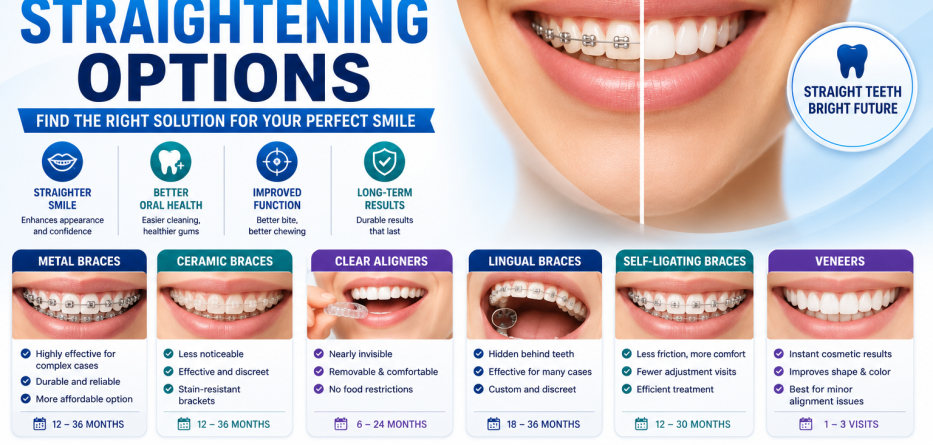
| Treatment | Visibility | Removable | Treatment Time | Best For |
|---|---|---|---|---|
| Metal Braces | Visible | No | 12–36 Months | Complex Cases |
| Ceramic Braces | Less Visible | No | 12–36 Months | Moderate to Complex Cases |
| Clear Aligners | Nearly Invisible | Yes | 6–24 Months | Mild to Moderate Cases |
| Lingual Braces | Hidden | No | 12–36 Months | Cosmetic-Focused Patients |
| Self-Ligating Braces | Visible | No | 12–30 Months | Various Cases |
| Veneers | Natural Appearance | No | 1–3 Visits | Minor Cosmetic Issues |
Teeth Straightening for Adults
More adults than ever are seeking orthodontic treatment.
Popular adult choices include:
- Clear aligners
- Ceramic braces
- Lingual braces
Adults often prioritize the following:
- Aesthetics
- Convenience
- Professional appearance
Modern orthodontic solutions make treatment more discreet than ever before.
How Long Does Teeth Straightening Take?
Treatment time varies depending on:
- Severity of misalignment
- Age
- Treatment type
- Patient compliance
Average Treatment Times
| Treatment | Typical Duration |
|---|---|
| Clear Aligners | 6–24 Months |
| Metal Braces | 18–36 Months |
| Ceramic Braces | 18–36 Months |
| Lingual Braces | 18–36 Months |
Your orthodontist will provide a personalized timeline.
How Much Does Teeth Straightening Cost?
Several factors influence treatment costs:
- Treatment complexity
- Location
- Orthodontist experience
- Type of appliance
Generally:
- Metal braces are often the most economical.
- Ceramic braces cost more.
- Clear aligners vary widely.
- Lingual braces are often among the most expensive options.
A consultation can provide an accurate estimate.
Choosing the Right Teeth Straightening Option
The best treatment depends on:
Your Alignment Issues
Complex cases may require traditional braces.
Your Budget
Treatment costs vary significantly.
Your Lifestyle
Professionals often prefer clear aligners or lingual braces.
Your Desired Appearance
Some patients prioritize discreet treatment.
Orthodontist Recommendations
A professional evaluation helps determine the most effective solution.
Frequently Asked Questions
What is the best teeth-straightening option?
The best option depends on your individual needs. Clear aligners are popular for mild to moderate cases, while braces remain ideal for complex corrections.
Are clear aligners as effective as braces?
For many cases, yes. However, severe orthodontic issues may require braces.
Can adults straighten their teeth?
Absolutely. Adults of all ages can benefit from orthodontic treatment.
How painful is teeth straightening?
Patients may experience mild pressure or discomfort after adjustments, but treatment is generally well tolerated.
How long do I need to wear a retainer?
Most patients need long-term retainer use to maintain results.
Are veneers a replacement for braces?
No. Veneers improve appearance but do not correct significant alignment problems.
Conclusion
Modern dentistry offers a wide range of effective teeth straightening options to suit different needs, lifestyles, and budgets. Whether you choose traditional braces, ceramic braces, clear aligners, or another treatment, achieving a straighter smile can improve both your appearance and oral health.
The best way to determine the right solution is through a consultation with an experienced orthodontist. With today’s advanced technologies and treatment options, a healthier, more confident smile is more achievable than ever.
