
Missing multiple teeth can significantly affect your appearance, confidence, speech, and ability to chew comfortably. Fortunately, modern implant dentistry offers highly effective solutions for replacing several missing teeth without relying on traditional removable dentures.
Many patients wonder, “Can dental implants replace multiple teeth?” The answer is yes. Dental implants can replace several missing teeth, whether they are located next to each other, spread throughout the mouth, or even if an entire arch of teeth is missing.
Thanks to advances in dental technology, implant-supported restorations provide a durable, natural-looking, and long-lasting solution that closely mimics natural teeth.
In this article, we’ll explain how dental implants replace multiple teeth, available treatment options, benefits, costs, and what patients can expect during treatment.
Can Dental Implants Replace More Than One Tooth?
Quick Answer
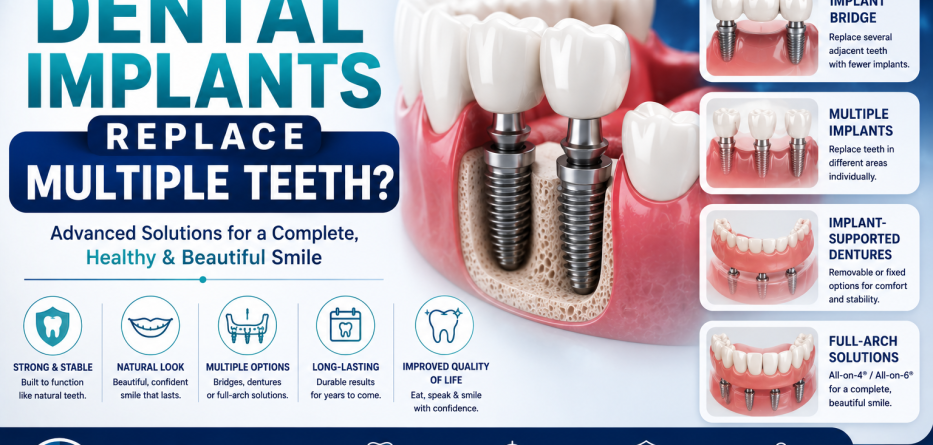
Yes. Dental implants can successfully replace multiple missing teeth using various treatment methods, including:
- Implant-supported bridges
- Multiple individual implants
- Implant-supported dentures
- Full-arch dental implants
- All-on-4® and All-on-6® systems
The best option depends on the number of missing teeth, bone health, budget, and overall treatment goals.
How Dental Implants Work
A dental implant is a titanium post that is surgically placed into the jawbone to replace a missing tooth root.
Once the implant fuses with the bone through osseointegration, it serves as a stable foundation for:
- Dental crowns
- Dental bridges
- Full or partial dentures
This allows implants to function similarly to natural teeth.
Replacing Several Adjacent Teeth
When multiple teeth are missing in the same area, dentists often recommend an implant-supported bridge.
What Is an Implant-Supported Bridge?
Instead of placing an implant for every missing tooth, two or more implants can support a bridge that replaces several teeth.
Example
If three teeth are missing consecutively:
- Two implants may be placed.
- A three-tooth bridge is attached.
Benefits
- Fewer implants required
- Lower treatment cost
- Excellent stability
- Natural appearance
Replacing Multiple Teeth in Different Areas
When missing teeth are spread throughout the mouth, individual implants may be the preferred solution.
Advantages
- Independent tooth replacement
- Preserves surrounding teeth
- Excellent chewing function
- Long-term durability
Each implant functions as its own tooth root.
Can Dental Implants Replace an Entire Arch of Teeth?
Absolutely.
Patients missing all upper or lower teeth may qualify for full-arch implant restorations.
Common Options
All-on-4 Dental Implants
Uses four strategically placed implants to support an entire arch of replacement teeth.
All-on-6 Dental Implants
Uses six implants for additional support and stability.
Benefits
- Fixed, non-removable teeth
- Improved comfort
- Better chewing ability
- Natural appearance
- Bone preservation
Many patients receive a new smile in a significantly shorter timeframe compared to traditional methods.
Implant-Supported Dentures
For patients seeking a more affordable solution, implant-supported dentures provide an excellent alternative.
Unlike traditional dentures, they are anchored securely to implants.
Benefits
- Reduced slipping
- Improved comfort
- Better speech
- Enhanced chewing function
- Increased confidence
Many patients find implant-supported dentures dramatically improve quality of life.
Benefits of Replacing Multiple Teeth with Dental Implants
Natural Appearance
Implant restorations are designed to match surrounding teeth in shape, size, and color.
Improved Chewing Function
Patients can enjoy foods that may be difficult with removable dentures.
Bone Preservation
Dental implants stimulate the jawbone and help prevent bone loss.
Long-Term Solution
With proper care, implants can last for decades.
Better Speech
Stable restorations reduce pronunciation issues caused by missing teeth or loose dentures.
Dental Implants vs Traditional Bridges and Dentures
| Feature | Dental Implants | Bridges | Dentures |
|---|---|---|---|
| Bone Preservation | Yes | Limited | No |
| Stability | Excellent | Good | Moderate |
| Lifespan | 20+ Years | 5–15 Years | 5–10 Years |
| Natural Feel | Excellent | Good | Moderate |
| Removable | No | No | Usually Yes |
Dental implants are generally considered the most durable and biologically beneficial option.
Who Is a Candidate for Multiple Dental Implants?
Ideal candidates typically have:
- Healthy gums
- Adequate bone density
- Good oral hygiene
- Stable overall health
Even patients with bone loss may qualify after bone grafting procedures.
Factors Evaluated
- Number of missing teeth
- Bone volume
- Medical history
- Smoking habits
- Treatment goals
A comprehensive dental evaluation helps determine the most suitable treatment plan.
What Is the Treatment Process?
Step 1: Consultation
The dentist performs the following:
- Clinical examination
- Digital imaging
- Treatment planning
Step 2: Implant Placement
Implants are surgically placed into the jawbone.
Step 3: Healing and Osseointegration
The implants integrate with the bone over several months.
Step 4: Restoration Placement
Custom crowns, bridges, or dentures are attached.
Step 5: Maintenance
Regular dental visits and good oral hygiene support long-term success.
How Long Do Multiple-Tooth Implants Last?
Dental implant posts can often last a lifetime with proper care.
Average Lifespan
| Component | Lifespan |
|---|---|
| Implant Post | 20+ Years |
| Bridge | 10–15 Years |
| Implant Denture | 10–15 Years |
Factors affecting longevity include:
- Oral hygiene
- Smoking
- Gum health
- Professional maintenance
Potential Risks and Considerations
Although implant treatment is highly successful, potential risks include the following:
- Infection
- Implant failure
- Bone loss
- Healing complications
- Additional procedures such as bone grafting
Fortunately, implant success rates often exceed 95%.
Frequently Asked Questions
Can two dental implants support multiple teeth?
Yes. Two implants can often support a bridge replacing three or more teeth.
Do I need an implant for every missing tooth?
Not necessarily. Implant-supported bridges and full-arch solutions often require fewer implants than missing teeth.
Can implants replace all my teeth?
Yes. Full-arch solutions such as All-on-4 and All-on-6 can replace an entire upper or lower arch.
Are implant-supported dentures better than traditional dentures?
Many patients find them more comfortable, stable, and functional.
How long does treatment take?
Depending on healing requirements, treatment may take several months from start to finish.
Conclusion
So, can dental implants replace multiple teeth?
Absolutely. Whether you’re missing a few teeth, several teeth in a row, or an entire arch, dental implants offer versatile solutions that restore function, appearance, and confidence. From implant-supported bridges to full-arch restorations, modern implant dentistry provides highly effective treatment options tailored to individual needs.
With proper planning, professional care, and good oral hygiene, dental implants can provide a long-lasting and natural-looking solution for replacing multiple missing teeth and improving overall quality of life.
