
Dental implants have become one of the most popular and effective solutions for replacing missing teeth. Unlike traditional dentures or dental bridges, implants provide a permanent foundation that looks, feels, and functions like natural teeth. But many patients still ask one important question: How do dental implants work?
The answer lies in a remarkable combination of modern dental technology and natural bone healing. Dental implants replace both the root and visible portion of a missing tooth, creating a stable and long-lasting restoration.
In this guide, you’ll learn exactly how dental implants work, the treatment process, benefits, recovery timeline, and why they are considered the gold standard for tooth replacement.
What Are Dental Implants?
A dental implant is an artificial tooth root that is surgically placed into the jawbone to support a replacement tooth.
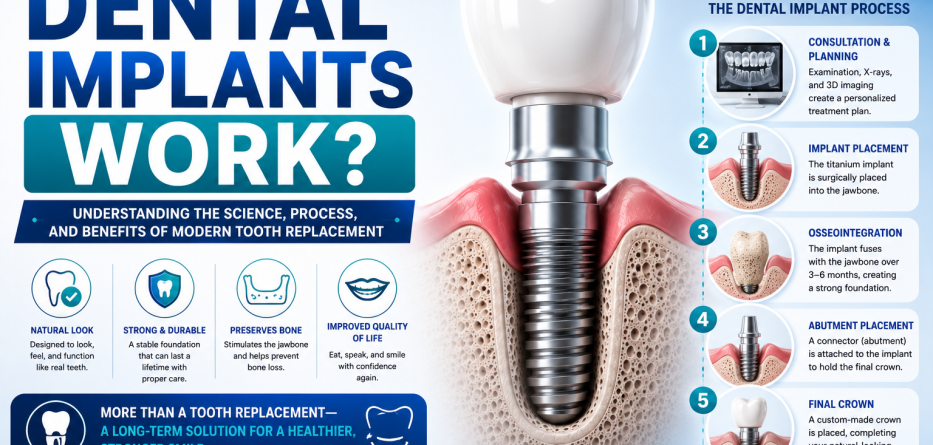
A complete dental implant consists of three parts:
1. Implant Post
The implant post is a small titanium screw placed into the jawbone. It acts as an artificial tooth root.
2. Abutment
The abutment is a connector that attaches the implant post to the final restoration.
3. Crown
The crown is the visible tooth-shaped restoration designed to match your natural teeth.
Together, these components create a durable and natural-looking tooth replacement.
How Do Dental Implants Work?
Dental implants work by replacing the missing tooth root and stimulating the jawbone just like a natural tooth.
After placement, the implant integrates with the surrounding bone through a biological process called osseointegration.
Once fully healed, the implant becomes a stable foundation for a crown, bridge, or denture.
Quick Answer
Dental implants work by fusing with the jawbone, creating a strong anchor that supports replacement teeth and restores natural function.
Step-by-Step: How the Dental Implant Process Works
Step 1: Initial Consultation
The dentist evaluates your oral health using:
- Dental examination
- Digital X-rays
- CBCT scans
- Medical history review
This helps determine whether you’re a good candidate for implants.
Step 2: Treatment Planning
A personalized treatment plan is created based on:
- Bone density
- Gum health
- Number of missing teeth
- Implant location
Advanced digital technology helps ensure precise placement.
Step 3: Implant Placement Surgery
During the procedure:
- Local anesthesia is administered.
- A small opening is made in the gum tissue.
- The titanium implant is inserted into the jawbone.
- The site is closed and allowed to heal.
Most patients report surprisingly little discomfort during the procedure.
Step 4: Osseointegration
This is the most important stage.
During healing, the jawbone grows around the implant and bonds directly to its surface.
This process is called osseointegration.
Why It Matters
Osseointegration provides:
- Stability
- Strength
- Long-term durability
- Natural tooth function
Without successful osseointegration, the implant cannot properly support a restoration.
The Science Behind Osseointegration
The key to implant success is the body’s ability to accept titanium.
The implant gradually becomes integrated into the bone, functioning similarly to a natural tooth root.
Benefits of Osseointegration
- Prevents implant movement
- Supports chewing forces
- Preserves jawbone density
- Improves long-term success rates
Modern implant success rates often exceed 95%.
How Long Does the Process Take?
The timeline varies depending on individual circumstances.
| Treatment Stage | Typical Time |
|---|---|
| Consultation | 1 Visit |
| Implant Placement | 1 Day |
| Healing & Osseointegration | 3–6 Months |
| Crown Placement | 1–2 Visits |
| Total Treatment Time | 3–9 Months |
Some patients may qualify for immediate-load implants that shorten treatment time.
Why Titanium Is Used for Dental Implants
Titanium has unique properties that make it ideal for dental implants.
Advantages of Titanium
- Biocompatible
- Lightweight
- Extremely durable
- Corrosion-resistant
- Integrates with bone
These characteristics contribute to high success rates and long-term stability.
What Happens After the Implant Heals?
Once osseointegration is complete:
- The dentist places the abutment.
- Impressions are taken.
- A custom-made crown is fabricated.
- The crown is attached to the implant.
The result is a fully functional replacement tooth that closely resembles a natural tooth.
How Dental Implants Compare to Other Tooth Replacement Options
| Feature | Dental Implants | Bridges | Dentures |
|---|---|---|---|
| Replace Tooth Root | Yes | No | No |
| Prevent Bone Loss | Yes | Limited | No |
| Stability | Excellent | Good | Moderate |
| Lifespan | 20+ Years | 5–15 Years | 5–10 Years |
| Natural Feel | Excellent | Good | Moderate |
Because implants replace the root structure, they offer benefits that other options cannot provide.
Benefits of Dental Implants
Natural Appearance
Implants blend seamlessly with surrounding teeth.
Improved Chewing Ability
Patients can comfortably eat most foods without concern.
Better Speech
Unlike loose dentures, implants remain securely in place.
Bone Preservation
Implants stimulate the jawbone and help prevent bone loss.
Long-Term Durability
Many implants last decades with proper care.
Who Is a Good Candidate for Dental Implants?
Ideal candidates generally have:
- Healthy gums
- Adequate bone density
- Good oral hygiene habits
- Controlled medical conditions
Even patients with bone loss may qualify through bone grafting procedures.
Caring for Dental Implants
Dental implants require care similar to natural teeth.
Daily Maintenance
- Brush twice daily
- Floss regularly
- Use recommended oral hygiene products
- Attend regular dental checkups
Proper maintenance helps maximize implant longevity.
Common Myths About Dental Implants
Myth: Dental Implants Are Painful
Most patients report only mild discomfort during recovery.
Myth: Implants Look Artificial
Modern restorations are designed to match natural teeth.
Myth: Older Adults Cannot Get Implants
Age alone is rarely a limiting factor.
Myth: Implants Require Special Cleaning
Routine brushing and flossing are usually sufficient.
Frequently Asked Questions
How do dental implants stay in place?
Dental implants fuse directly with the jawbone through osseointegration, creating a stable foundation.
Are dental implants permanent?
The implant post can often last a lifetime with proper care.
Can implants replace multiple teeth?
Yes. Implants can support crowns, bridges, or full-arch restorations.
How successful are dental implants?
Success rates commonly range between 95% and 98%.
Do implants feel like natural teeth?
Yes. Once healed, implants often feel very similar to natural teeth.
Conclusion
Dental implants work by replacing the missing tooth root and integrating with the jawbone through a natural biological process called osseointegration. This creates a strong, stable foundation that supports replacement teeth and restores normal function.
Because they preserve bone health, provide exceptional durability, and closely mimic natural teeth, dental implants remain one of the most advanced and successful tooth replacement solutions available today. For patients seeking a long-lasting and confident smile, understanding how dental implants work is the first step toward making an informed treatment decision.
