
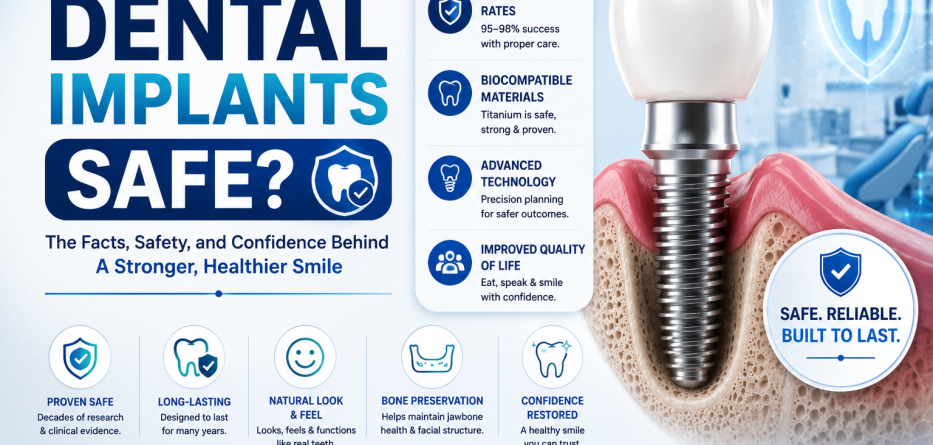
Dental implants have become one of the most popular and effective solutions for replacing missing teeth. Millions of people worldwide have chosen dental implants because they provide a natural appearance, exceptional stability, and long-term functionality. However, many patients considering treatment have one important question: Are dental implants safe?
The short answer is yes. Dental implants are considered one of the safest and most predictable procedures in modern dentistry. With decades of research, advanced technology, and high success rates, dental implants have established themselves as the gold standard for tooth replacement.
In this guide, we’ll explore the safety of dental implants, potential risks, success rates, who qualifies for treatment, and how dentists ensure safe outcomes.
What Are Dental Implants?
A dental implant is a small titanium post that is surgically placed into the jawbone to replace a missing tooth root. Once the implant integrates with the bone through a process called osseointegration, a custom-made crown, bridge, or denture is attached.
A complete dental implant consists of:
- Implant post
- Abutment
- Dental crown
The result is a restoration that looks, feels, and functions like a natural tooth.
Are Dental Implants Safe?
Quick Answer
Yes. Dental implants are widely recognized as a safe and effective treatment for replacing missing teeth. Studies consistently show success rates of over 95% when implants are placed by qualified professionals and patients maintain proper oral hygiene.
Dental implants have been successfully used for more than 50 years and are supported by extensive clinical research.
Why Are Dental Implants Considered Safe?
Several factors contribute to the safety of dental implants.
Biocompatible Materials
Most dental implants are made from titanium, a material known for its excellent compatibility with the human body.
Titanium offers:
- High strength
- Corrosion resistance
- Long-term durability
- Excellent bone integration
Because titanium bonds naturally with bone tissue, it creates a secure and stable foundation.
Decades of Scientific Research
Dental implant technology has evolved significantly since the 1960s.
Today, implant procedures are backed by:
- Long-term clinical studies
- Advanced surgical techniques
- Modern imaging technology
- Proven treatment protocols
This extensive research helps dentists provide highly predictable results.
High Success Rates
Numerous studies have demonstrated impressive success rates.
| Treatment | Average Success Rate |
|---|---|
| Dental Implants | 95–98% |
| Traditional Bridges | Lower Long-Term Survival |
| Removable Dentures | Variable |
With proper care, many implants remain functional for decades.
Benefits of Safe Dental Implant Treatment
Patients choose dental implants because they offer several advantages.
Improved Function
Implants restore chewing power and allow patients to eat a wide variety of foods comfortably.
Natural Appearance
Custom restorations blend seamlessly with surrounding teeth.
Bone Preservation
Unlike dentures, implants stimulate the jawbone and help prevent bone loss.
Long-Term Reliability
Many implants last 20 years or longer with proper maintenance.
What Are the Risks of Dental Implants?
Although dental implants are generally safe, every surgical procedure carries some level of risk.
Potential complications may include:
Infection
Bacteria can infect the implant site if proper hygiene is not maintained.
Implant Failure
In rare cases, the implant may fail to integrate with the bone.
Nerve Injury
Improper implant placement can occasionally affect nearby nerves.
Sinus Complications
Upper jaw implants placed near the sinus cavity require careful planning.
Delayed Healing
Certain medical conditions or smoking may slow recovery.
Fortunately, these complications are uncommon when treatment is performed by experienced professionals.
Who Is a Good Candidate for Dental Implants?
Most healthy adults are candidates for implant treatment.
Ideal candidates typically have:
- Healthy gums
- Adequate jawbone density
- Good oral hygiene habits
- Stable overall health
Even patients with bone loss may qualify after procedures such as bone grafting.
Factors That Improve Dental Implant Safety
Choose an Experienced Implant Dentist
Professional expertise plays a significant role in treatment success.
An experienced implant dentist can:
- Evaluate bone structure accurately
- Use advanced imaging technology
- Plan precise implant placement
- Minimize complications
Follow Post-Operative Instructions
Patients should carefully follow all aftercare recommendations, including:
- Taking prescribed medications
- Maintaining oral hygiene
- Avoiding smoking
- Attending follow-up appointments
Maintain Excellent Oral Hygiene
Healthy gums are essential for long-term implant success.
Daily care should include:
- Brushing twice daily
- Flossing regularly
- Using recommended oral hygiene products
- Professional dental cleanings
Are Dental Implants Safe for Older Adults?
Yes.
Age alone is not usually a limiting factor for implant treatment.
Many adults in their 60s, 70s, and even 80s successfully receive dental implants.
More important factors include the following:
- Bone quality
- Overall health
- Medical history
- Healing ability
A comprehensive evaluation helps determine candidacy.
Are Dental Implants Safe for Patients with Medical Conditions?
Many patients with medical conditions can safely receive implants.
Conditions that may require special consideration include:
- Diabetes
- Osteoporosis
- Heart disease
- Autoimmune disorders
Proper medical management and treatment planning often allow successful implant placement.
Patients should always disclose their complete medical history to their dentist.
How Dentists Make Dental Implant Procedures Safer
Modern implant dentistry utilizes advanced technology to improve safety and precision.
3D CBCT Imaging
Provides detailed views of:
- Bone density
- Nerve pathways
- Sinus locations
Computer-Guided Surgery
Allows highly accurate implant placement.
Digital Treatment Planning
Helps dentists identify potential challenges before surgery begins.
These technologies significantly reduce complications and improve outcomes.
Common Myths About Dental Implant Safety
Myth 1: Dental Implants Are Dangerous
Fact: Dental implants have one of the highest success rates in dentistry.
Myth 2: The Body Rejects Dental Implants
Fact: Titanium implants are highly biocompatible and rarely rejected.
Myth 3: Implant Surgery Is Extremely Painful
Fact: Most patients report minimal discomfort and return to normal activities quickly.
Myth 4: Dental Implants Are Only for Younger People
Fact: Healthy older adults are often excellent candidates.
Tips for Safe and Successful Dental Implants
To maximize implant success:
- Choose a qualified implant dentist.
- Follow all aftercare instructions.
- Maintain excellent oral hygiene.
- Avoid tobacco products.
- Attend regular dental checkups.
- Manage underlying medical conditions.
- Wear a nightguard if you grind your teeth.
These habits significantly improve long-term outcomes.
Frequently Asked Questions
Are dental implants safe long-term?
Yes. Many dental implants remain functional and healthy for 20 years or longer.
What is the success rate of dental implants?
Success rates typically range between 95% and 98%.
Can dental implants cause health problems?
Serious complications are rare. Most issues can be prevented through proper planning and oral care.
Is implant surgery painful?
Most patients experience only mild discomfort during recovery.
Are titanium dental implants safe?
Yes. Titanium has been safely used in medical and dental procedures for decades.
Can smokers safely get dental implants?
Yes, although smoking increases the risk of complications and implant failure.
Conclusion
So, are dental implants safe?
The answer is a resounding yes. Dental implants are one of the safest, most reliable, and most successful tooth replacement options available today. Backed by decades of research, advanced technology, and exceptional success rates, they offer a long-lasting solution for restoring both function and confidence.
By choosing an experienced implant dentist, following proper aftercare instructions, and maintaining excellent oral hygiene, patients can enjoy the benefits of safe and successful dental implants for many years to come.
