
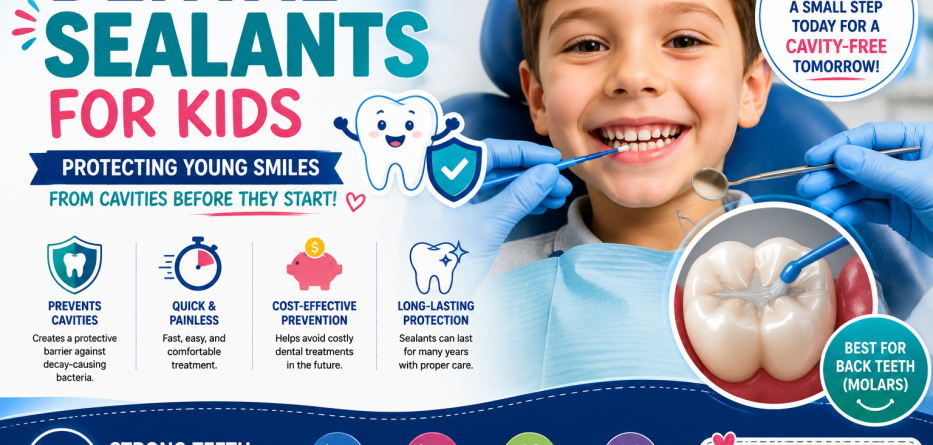
Protecting your child’s teeth from cavities is one of the most important steps you can take to support their long-term oral health. While brushing, flossing, and regular dental checkups are essential, they may not always be enough to prevent decay in hard-to-reach areas of the mouth. That’s where dental sealants for kids can make a significant difference.
Dental sealants are a safe, painless, and effective preventive treatment designed to protect children’s teeth from cavities. By creating a protective barrier over the chewing surfaces of molars, sealants help keep food particles and bacteria out of deep grooves where toothbrush bristles often can’t reach.
In this guide, you’ll learn what dental sealants are, how they work, their benefits, and why many dentists recommend them as part of a comprehensive preventive dental care plan.
What Are Dental Sealants?
Dental sealants are thin protective coatings made from a safe plastic resin material that is applied to the chewing surfaces of the back teeth.
These teeth, known as molars and premolars, contain deep grooves and pits that can trap:
- Food particles
- Plaque
- Bacteria
- Sugars
Sealants fill these grooves and create a smooth surface that makes teeth easier to clean.
Quick Definition
Dental sealants are protective coatings applied to children’s molars to help prevent cavities by blocking bacteria and food particles from collecting in deep grooves.
Why Do Kids Need Dental Sealants?
Children are particularly susceptible to tooth decay because
- They often consume sugary foods and drinks.
- Developing brushing habits may not be perfect.
- Molars have deep grooves that are difficult to clean.
- Bacteria can easily accumulate in hard-to-reach areas.
Even with good oral hygiene, molars remain at high risk for cavities.
Sealants provide an additional layer of protection during the years when children are most vulnerable to tooth decay.
How Do Dental Sealants Work?
Dental sealants act as a shield against cavity-causing bacteria.
When applied to the chewing surface of a tooth, the sealant bonds to the enamel and covers tiny pits and fissures.
Benefits of the Protective Barrier
- Prevents food from getting trapped
- Reduces plaque accumulation
- Blocks harmful bacteria
- Makes brushing more effective
- Lowers cavity risk
The sealant essentially creates a smoother surface that is easier to keep clean.
Which Teeth Receive Dental Sealants?
Dentists most commonly apply sealants to:
First Permanent Molars
These usually erupt around ages 6 to 7.
Second Permanent Molars
These typically emerge around ages 11 to 13.
These teeth are responsible for much of the chewing function and are particularly prone to decay.
In some cases, sealants may also be recommended for baby teeth if they have deep grooves and a high risk of cavities.
Benefits of Dental Sealants for Kids
1. Effective Cavity Prevention
Dental sealants significantly reduce the risk of decay in molars.
Research has shown that sealants can lower cavity risk by up to 80% in the first few years after application.
2. Quick and Painless Procedure
The application process is completely non-invasive.
No:
- Drilling
- Injections
- Anesthesia
are required.
3. Cost-Effective Prevention
Preventing cavities is typically less expensive than treating them.
Sealants can help families avoid the following:
- Fillings
- Crowns
- Root canals
- Tooth extractions
4. Long-Lasting Protection
Sealants can remain effective for several years with proper maintenance.
5. Supports Better Oral Health Habits
Children who receive preventive dental care often develop greater awareness of oral hygiene.
The Dental Sealant Procedure
Applying dental sealants is a simple process that usually takes only a few minutes per tooth.
Step 1: Cleaning the Tooth
The dentist thoroughly cleans and dries the tooth.
Step 2: Preparing the Surface
A special solution is applied to help the sealant bond effectively.
Step 3: Applying the Sealant
The liquid sealant is carefully painted onto the chewing surface.
Step 4: Hardening the Material
A curing light is used to harden the sealant.
Step 5: Final Evaluation
The dentist checks the sealant to ensure proper placement.
The entire process is quick, comfortable, and painless.
Are Dental Sealants Safe for Children?
Yes.
Dental sealants have been used safely for decades and are recommended by many dental organizations.
They are considered:
- Safe
- Effective
- Non-toxic
- Minimally invasive
Parents often appreciate sealants because they provide protection without causing discomfort.
How Long Do Dental Sealants Last?
Most dental sealants last between
- 5 and 10 years
During routine dental visits, the dentist will examine the sealants for signs of wear or damage.
If necessary, sealants can be repaired or replaced easily.
Dental Sealants vs Fluoride Treatments
Many parents wonder whether sealants replace fluoride treatments.
The answer is no.
Dental Sealants
Protect the chewing surfaces of molars.
Fluoride Treatments
Strengthen tooth enamel throughout the mouth.
Best Approach
Using both treatments provides the highest level of protection against cavities.
Signs Your Child May Benefit from Dental Sealants
Your dentist may recommend sealants if your child:
- Has newly erupted molars
- Has deep grooves in their teeth
- Has a history of cavities
- Is at high risk for tooth decay
- Has difficulty cleaning back teeth effectively
Early application often provides the greatest benefit.
How to Care for Dental Sealants
Dental sealants require minimal special care.
Children should continue to
- Brushing twice daily
- Flossing daily
- Limiting sugary snacks
- Drinking water regularly
- Attending routine dental checkups
Healthy habits help maximize the effectiveness of sealants.
Frequently Asked Questions
At what age should kids get dental sealants?
Most children receive sealants when their first permanent molars erupt around age 6 and again when second molars appear around age 12.
Are dental sealants painful?
No. The procedure is painless and does not require injections or drilling.
How effective are dental sealants?
Sealants can reduce cavity risk in molars by up to 80% during the first several years after application.
Can sealants be applied to baby teeth?
In some cases, yes. Dentists may recommend sealants for baby teeth that have deep grooves and a high risk of decay.
How long do sealants last?
Most dental sealants last between 5 and 10 years with proper care.
Do dental sealants replace brushing and flossing?
No. Sealants complement good oral hygiene but do not replace daily brushing and flossing.
Conclusion
Dental sealants for kids are one of the simplest and most effective ways to protect young teeth from cavities. By creating a protective barrier over vulnerable molars, sealants help prevent decay, reduce future dental treatment needs, and support long-term oral health.
Safe, painless, and cost-effective, dental sealants are an excellent investment in your child’s smile. Combined with regular brushing, flossing, fluoride treatments, and routine dental checkups, sealants can help keep your child’s teeth healthy and cavity-free for years to come.
