
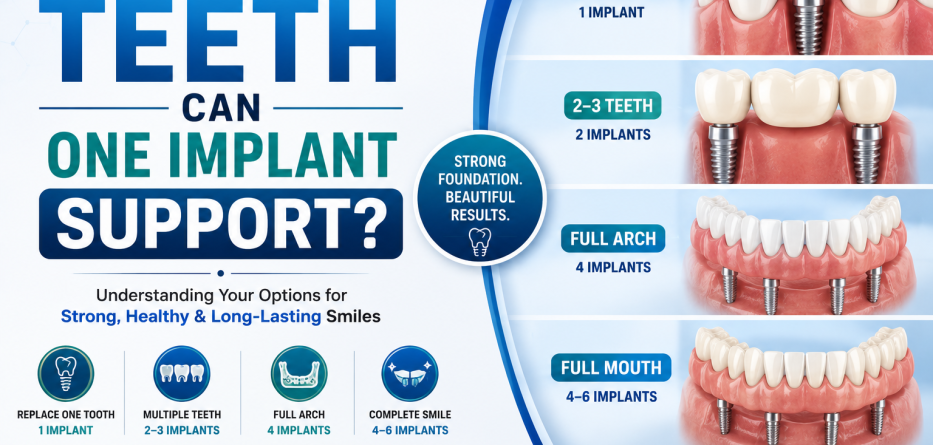
Dental implants have transformed modern dentistry by providing a strong, long-lasting solution for replacing missing teeth. One of the most common questions patients ask is, “How many teeth can one implant support?”
The answer depends on several factors, including the location of the missing teeth, the quality of the jawbone, the type of restoration being used, and the patient’s overall oral health. While a single implant is often used to replace one tooth, it can sometimes support multiple teeth under specific circumstances.
In this guide, we’ll explain how dental implants work, how many teeth a single implant can support, and the treatment options available for replacing one, several, or even an entire arch of missing teeth.
Understanding How Dental Implants Work
A dental implant acts as an artificial tooth root. It is surgically placed into the jawbone, where it fuses with the bone through a process called osseointegration.
A complete implant restoration consists of:
- Implant post
- Abutment
- Dental crown, bridge, or denture
Once integrated with the jawbone, the implant provides a stable foundation capable of supporting chewing forces similar to natural teeth.
Can One Implant Support One Tooth?
Yes.
The most common use of a dental implant is replacing a single missing tooth.
Single Tooth Replacement
When one tooth is missing, one implant is usually placed into the jawbone and topped with a custom-made crown.
Benefits
- Preserves surrounding teeth
- Prevents bone loss
- Looks natural
- Functions like a natural tooth
- Long-lasting solution
This is considered the gold standard for single-tooth replacement.
Can One Implant Support Two Teeth?
In some cases, yes.
When two adjacent teeth are missing, one implant may be able to support a small cantilever bridge.
However, dentists generally evaluate the following:
- Bite pressure
- Bone density
- Implant location
- Overall oral health
Situations Where It May Work
- Front teeth with lower chewing forces
- Smaller teeth requiring less support
- Specific clinical circumstances
Not every patient is a suitable candidate for this approach.
Can One Implant Support Three Teeth?
Generally, one implant is not recommended to support three teeth.
The chewing forces generated during daily function can place excessive stress on a single implant.
Instead, dentists often recommend:
- Two implants supporting a three-unit bridge
- Three individual implants
- Implant-supported bridge solutions
This provides better long-term stability and reduces the risk of implant complications.
How Multiple Teeth Are Replaced With Dental Implants
Implant-Supported Bridges
When several adjacent teeth are missing, dentists can use fewer implants than the number of teeth being replaced.
Example:
| Missing Teeth | Typical Number of Implants |
|---|---|
| 3 Teeth | 2 Implants |
| 4 Teeth | 2–3 Implants |
| 5 Teeth | 3 Implants |
The bridge spans the gap while the implants provide support.
Benefits
- Fewer implants required
- Reduced treatment costs
- Excellent stability
- Preserves jawbone health
How Many Teeth Can Two Implants Support?
Two implants can often support the following:
- Three teeth
- Four teeth
- Small dental bridges
This is a common solution for patients missing several adjacent teeth.
Advantages
- Better force distribution
- Increased durability
- Improved chewing efficiency
- Reduced stress on individual implants
How Many Teeth Can Four Implants Support?
Four implants can support an entire arch of teeth in many cases.
This treatment concept is commonly known as All-on-4®.
What Is All-on-4?
Four strategically placed implants support a full-arch prosthesis.
This approach can replace the following:
- 10 to 14 upper teeth
- 10 to 14 lower teeth
Benefits
- Fewer implants required
- Faster treatment
- Improved stability
- Full smile restoration
Many patients can receive a temporary set of teeth on the same day as implant placement.
Can One Implant Support an Entire Denture?
No.
A single implant is generally insufficient to support a complete denture.
However, implant-retained dentures may use:
| Denture Type | Typical Number of Implants |
| Lower Denture | 2–4 Implants |
| Upper Denture | 4–6 Implants |
| Full Arch Fixed Bridge | 4–8 Implants |
The exact number depends on bone availability and treatment goals.
Factors That Determine How Many Teeth One Implant Can Support
Several clinical factors influence treatment planning.
Bone Density
Stronger jawbone provides better support for implants.
Implant Size
Wider and longer implants may support greater chewing forces.
Implant Location
Front teeth experience different forces than back teeth.
Bite Forces
Patients who grind or clench their teeth may require additional implant support.
Overall Oral Health
Healthy gums and good oral hygiene contribute to long-term success.
Advantages of Implant-Supported Restorations
Whether replacing one tooth or multiple teeth, dental implants offer numerous benefits.
Key Advantages
- Natural appearance
- Improved chewing ability
- Long-term durability
- Bone preservation
- Better speech
- Increased confidence
- Reduced movement compared to dentures
These benefits make implants one of the most effective tooth replacement solutions available.
How Dentists Determine the Number of Implants Needed
Every patient receives a customized treatment plan.
Dentists typically evaluate:
- Number of missing teeth
- Bone density
- Gum health
- Bite alignment
- Smile goals
- Budget considerations
Advanced technologies such as 3D imaging and digital treatment planning help determine the ideal implant placement strategy.
Frequently Asked Questions
Can one implant hold two crowns?
In selected cases, one implant may support two connected crowns, but this depends on location and bite forces.
Is it better to have one implant per tooth?
Not always. Implant-supported bridges can effectively replace multiple teeth using fewer implants.
How many teeth can four implants support?
Four implants can often support a full arch of 10 to 14 replacement teeth.
Can a single implant support a bridge?
Yes. In certain situations, a single implant may support a small bridge, though multiple implants are often preferred.
How long do implant-supported bridges last?
With proper care, implant-supported bridges can last many years and often exceed the lifespan of traditional bridges.
Conclusion
So, how many teeth can one implant support?
In most cases, a single dental implant is designed to support one tooth. However, depending on the patient’s anatomy and treatment goals, one implant may sometimes support two teeth, while multiple implants can support bridges, dentures, or even an entire arch of replacement teeth.
The ideal solution depends on factors such as bone quality, implant location, bite forces, and overall oral health. A comprehensive evaluation by an experienced implant dentist can determine the most effective and long-lasting treatment plan for restoring your smile.
