
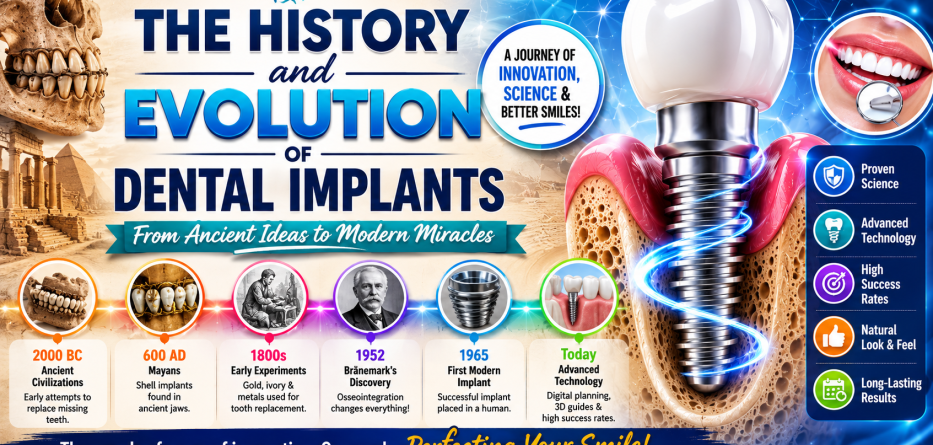
Dental implants are widely regarded as one of the most significant advancements in modern dentistry. Today, they offer a reliable, natural-looking, and long-lasting solution for replacing missing teeth. However, the journey to modern dental implants spans thousands of years and involves remarkable discoveries, scientific breakthroughs, and technological innovations.
The history and evolution of dental implants reveal how ancient civilizations experimented with tooth replacement and how modern researchers transformed those early ideas into one of the most successful procedures in dentistry.
In this article, we’ll explore the fascinating story of dental implants, from ancient attempts at replacing missing teeth to the cutting-edge implant technologies used today.
What Are Dental Implants?
A dental implant is an artificial tooth root that is surgically placed into the jawbone to support a crown, bridge, or denture.
Modern implants typically consist of:
- Titanium implant post
- Abutment
- Dental restoration
Their success relies on a biological process called osseointegration, where the implant fuses with the surrounding bone.
Early Attempts at Tooth Replacement
The desire to replace missing teeth dates back thousands of years.
Ancient China (Around 2000 BC)
Historical evidence suggests that ancient Chinese civilizations used carved bamboo pegs to replace missing teeth.
Although primitive by today’s standards, these early efforts demonstrated a desire to restore both function and appearance.
Ancient Egypt
Archaeological findings have revealed human remains with replacement teeth secured using gold wire.
These discoveries indicate that dental restoration was practiced even in ancient times.
Ancient Mayans (Around 600 AD)
One of the most remarkable discoveries in implant history comes from the ancient Maya civilization.
Researchers found a mandible containing shell fragments placed where teeth had been lost.
Evidence suggests that bone tissue formed around some of these shell implants, resembling a primitive form of osseointegration.
The Middle Ages and Early Dentistry
During the Middle Ages, tooth replacement methods remained limited.
Common solutions included:
- Animal teeth
- Human donor teeth
- Ivory replacements
- Wooden prosthetics
These options often suffered from poor durability and a high risk of infection.
The lack of modern surgical techniques and sterilization limited long-term success.
The 18th and 19th Centuries: Experimental Implant Concepts
As dentistry advanced, practitioners began experimenting with new materials.
Gold and Precious Metals
Dentists explored implants made from:
- Gold
- Silver
- Platinum
While these materials offered improved durability, they failed to integrate effectively with bone.
Dr. Maggiolo’s Implant (1809)
One of the earliest documented implant attempts involved placing a gold implant into a fresh extraction socket.
Although innovative, the procedure lacked the biological understanding necessary for long-term success.
The Early 20th Century: Modern Implant Research Begins
The early 1900s marked significant progress in implant design.
Researchers experimented with:
- Porcelain
- Gold alloys
- Cobalt-chromium alloys
- Stainless steel
The Strock Brothers (1930s)
Dentists Alvin and Moses Strock introduced implants made from Vitallium, a cobalt-chromium alloy commonly used in orthopedic surgery.
This represented one of the first successful attempts at modern implant dentistry.
However, long-term predictability remained a challenge.
The Discovery That Changed Everything
Per-Ingvar Brånemark and Osseointegration
The most important breakthrough in implant dentistry occurred in the 1950s.
Swedish orthopedic surgeon Per-Ingvar Brånemark was studying bone healing using titanium chambers placed in rabbit bone.
When he attempted to remove the chambers, he discovered that the titanium had fused directly with the bone.
This phenomenon became known as osseointegration.
Why This Discovery Was Revolutionary
Brånemark’s research demonstrated that titanium could become permanently integrated with living bone.
This breakthrough provided the scientific foundation for modern dental implants.
The First Modern Dental Implants
In 1965, Brånemark placed the first titanium dental implant into a human patient.
The implant functioned successfully for decades.
This remarkable success proved that osseointegrated implants could serve as a long-term solution for tooth replacement.
By the 1970s and 1980s, clinical studies consistently demonstrated high success rates.
The Rise of Implant Dentistry in the 1980s and 1990s
As research expanded, dental implants gained widespread acceptance.
Key Developments
- Improved implant designs
- Better surgical techniques
- Enhanced treatment planning
- Increased professional training
Benefits included:
- Greater stability
- Improved aesthetics
- Better patient outcomes
Implants gradually became the preferred alternative to traditional dentures and bridges.
The Evolution of Implant Materials
Titanium Implants
Titanium remains the gold standard because it is:
- Biocompatible
- Durable
- Corrosion-resistant
- Highly compatible with bone tissue
Zirconia Implants
More recently, zirconia implants have emerged as a metal-free alternative.
Advantages include:
- Tooth-colored appearance
- Excellent aesthetics
- Biocompatibility
Although promising, titanium remains the most extensively researched implant material.
Modern Advances in Dental Implant Technology
Today’s implant procedures are dramatically different from those of previous decades.
3D Cone Beam CT Imaging
Dentists can now evaluate:
- Bone density
- Nerve locations
- Sinus anatomy
- Implant positioning
with remarkable accuracy.
Digital Treatment Planning
Computer-guided planning helps optimize implant placement and reduce complications.
Guided Implant Surgery
Advanced surgical guides allow highly precise implant placement.
Surface Technology
Modern implants feature specially treated surfaces that:
- Accelerate healing
- Improve osseointegration
- Increase long-term stability
Dental Implant Success Rates Today
Modern dental implants are among the most successful treatments in healthcare.
Average Success Rates
| Implant Procedure | Success Rate |
|---|---|
| Single Tooth Implant | 95–98% |
| Multiple Implants | 95%+ |
| Full Arch Implants | 90–98% |
Many implants remain functional for 20 years or longer.
The Future of Dental Implants
Research continues to drive innovation.
Emerging technologies include:
Artificial Intelligence
AI-assisted planning may improve accuracy and predictability.
3D Printed Implants
Customized implants could offer improved patient-specific solutions.
Regenerative Dentistry
Scientists are exploring ways to regenerate bone and dental tissues.
Smart Implant Technology
Future implants may include sensors that monitor health and performance.
These advancements could further improve outcomes and patient experiences.
Why Understanding Implant History Matters
The evolution of dental implants demonstrates how scientific discovery, clinical research, and technological innovation can transform patient care.
Today’s patients benefit from:
- Decades of research
- Proven treatment protocols
- Advanced materials
- Exceptional success rates
Understanding this history helps patients appreciate the safety and effectiveness of modern implant dentistry.
Frequently Asked Questions
Who invented modern dental implants?
Modern dental implants were developed through the pioneering research of Per-Ingvar Brånemark, who discovered osseointegration.
What were the first dental implants made from?
Ancient implants used materials such as bamboo, shells, ivory, and precious metals.
Why is titanium used in dental implants?
Titanium is biocompatible and capable of integrating directly with bone through osseointegration.
How long have dental implants been used?
Primitive forms of tooth replacement date back thousands of years, while modern titanium implants have been used since the 1960s.
Are dental implants better today than in the past?
Yes. Modern implants benefit from advanced materials, digital planning, guided surgery, and extensive clinical research.
Conclusion
The history and evolution of dental implants is a remarkable story of innovation spanning thousands of years. From ancient civilizations experimenting with shells and bamboo to today’s highly sophisticated titanium implants, dental implant technology has undergone extraordinary development.
Thanks to groundbreaking discoveries such as osseointegration and continuous advancements in materials and digital dentistry, modern implants offer patients a safe, predictable, and long-lasting solution for missing teeth. As research continues, the future of dental implantology promises even greater precision, comfort, and success.
