
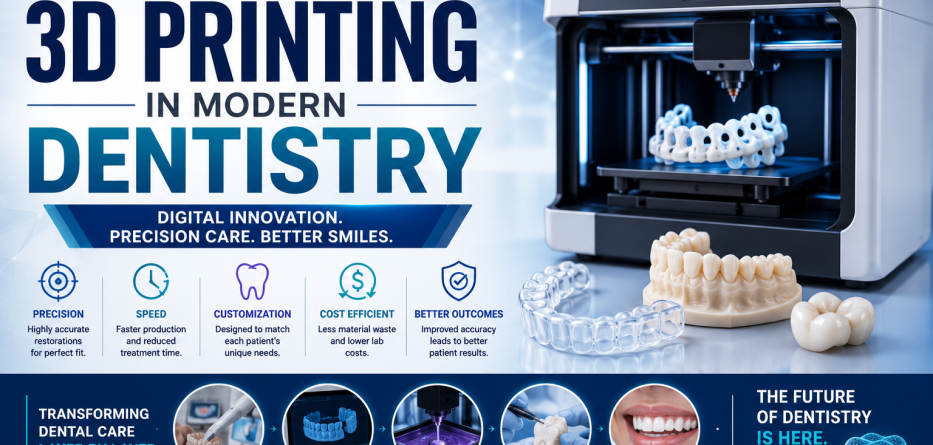
Technology continues to transform the field of dentistry, making treatments faster, more accurate, and more comfortable for patients. One of the most exciting innovations driving this transformation is 3D printing in modern dentistry.
From creating dental crowns and bridges to producing surgical guides and dentures, 3D printing has revolutionized how dental professionals diagnose, plan, and deliver treatment. By combining digital scanning with advanced manufacturing techniques, dentists can achieve exceptional precision while reducing treatment times and improving patient outcomes.
In this article, we’ll explore how 3D printing works in dentistry, its benefits, applications, and why it is becoming an essential tool in modern dental practices.
What Is 3D Printing in Dentistry?
3D printing, also known as additive manufacturing, is a process that creates physical dental models and restorations layer by layer using digital designs.
The process begins with a digital scan of the patient’s teeth and oral structures. Specialized software then converts this information into a 3D model that can be printed using dental-grade materials.
Quick Definition
3D printing in dentistry is a digital manufacturing process that allows dentists to create precise dental restorations, appliances, and surgical tools directly from computerized designs.
How Does Dental 3D Printing Work?
The process typically involves several steps.
Step 1: Digital Scanning
Dentists capture detailed images using:
- Intraoral scanners
- CBCT scans
- Digital impressions
Step 2: Computer-Aided Design (CAD)
The digital data is used to design:
- Crowns
- Bridges
- Aligners
- Dentures
- Surgical guides
Step 3: 3D Printing
The design is sent to a 3D printer that builds the object layer by layer.
Step 4: Finishing and Placement
The printed restoration is polished, adjusted, and fitted to the patient.
Why Is 3D Printing Important in Modern Dentistry?
Traditional dental workflows often involve multiple appointments, physical impressions, and laboratory delays.
3D printing offers significant advantages:
- Greater precision
- Faster production
- Improved patient comfort
- Reduced treatment times
- Enhanced customization
As a result, many dental practices are integrating this technology into everyday procedures.
Applications of 3D Printing in Dentistry
1. Dental Crowns and Bridges
3D printing enables highly accurate restorations that fit comfortably and function naturally.
Benefits include:
- Improved fit
- Faster turnaround
- Better aesthetics
- Reduced chair time
2. Dental Implants and Surgical Guides
Implant placement requires exceptional precision.
3D-printed surgical guides help dentists:
- Plan implant positioning
- Avoid nerves and sinuses
- Improve accuracy
- Reduce surgical risks
This technology significantly enhances implant success rates.
3. Orthodontic Aligners
Clear aligner systems rely heavily on digital technology.
3D printing allows orthodontists to create the following:
- Treatment models
- Custom aligners
- Retainers
This results in more predictable tooth movement and personalized treatment plans.
4. Dentures
Modern dentures can now be designed and manufactured digitally.
Advantages include:
- Better fit
- Faster fabrication
- Improved comfort
- Easy replacement if damaged
Digital records allow future reproductions without repeating impressions.
5. Dental Models
Dentists frequently use 3D-printed models for:
- Treatment planning
- Patient education
- Orthodontic analysis
- Surgical preparation
These models provide a highly accurate representation of oral structures.
Benefits of 3D Printing in Dentistry
Increased Accuracy
Digital workflows reduce human error and improve restoration precision.
Benefits include:
- Better fitting restorations
- Improved treatment outcomes
- Reduced adjustments
Faster Treatment Times
Traditional laboratory fabrication may take days or weeks.
3D printing can significantly shorten production times, allowing for:
- Faster delivery
- Fewer appointments
- Improved efficiency
Enhanced Patient Comfort
Digital impressions replace uncomfortable traditional molds.
Patients benefit from:
- Greater comfort
- Reduced gag reflex
- Faster scanning process
Improved Customization
Every patient’s mouth is unique.
3D printing enables highly personalized restorations that match individual anatomy.
Cost Efficiency
As technology advances, 3D printing helps reduce the following:
- Material waste
- Laboratory costs
- Production time
These efficiencies can contribute to more affordable treatment options.
3D Printing and Dental Implant Dentistry
Dental implant procedures have particularly benefited from digital workflows.
How 3D Printing Improves Implant Treatment
- Precise surgical guides
- Better implant positioning
- Reduced surgical complications
- Predictable treatment outcomes
Digital planning allows dentists to visualize treatment before surgery begins.
Materials Used in Dental 3D Printing
Several specialized materials are used depending on the application.
Common Materials
- Dental resins
- Biocompatible polymers
- Ceramic materials
- Metal alloys
- Composite materials
Each material is selected based on durability, aesthetics, and intended use.
Challenges and Limitations
Although highly beneficial, 3D printing has some limitations.
Potential Challenges
- Equipment costs
- Training requirements
- Material limitations
- Regulatory compliance
However, ongoing technological advancements continue to address these challenges.
The Future of 3D Printing in Dentistry
The future of dental 3D printing is incredibly promising.
Emerging innovations include:
- Fully printed permanent crowns
- Customized implant components
- Regenerative tissue engineering
- Artificial intelligence integration
- Same-day restorations
As technology evolves, dentists will be able to deliver even more precise and efficient care.
Traditional Dentistry vs 3D Printing
| Feature | Traditional Methods | 3D Printing |
|---|---|---|
| Accuracy | Good | Excellent |
| Production Time | Days to Weeks | Hours to Days |
| Customization | Moderate | High |
| Patient Comfort | Moderate | Excellent |
| Digital Workflow | Limited | Fully Integrated |
| Treatment Efficiency | Standard | Enhanced |
This comparison demonstrates why 3D printing is becoming increasingly popular in dental practices worldwide.
Frequently Asked Questions
Is 3D printing safe in dentistry?
Yes. Dental 3D printing uses biocompatible materials that meet strict safety standards.
Can 3D printers create dental implants?
While implant components may be manufactured using advanced printing technologies, most commonly 3D printing is used for surgical guides and treatment planning.
How accurate is dental 3D printing?
Modern dental printers produce highly precise restorations with exceptional accuracy.
Does 3D printing reduce treatment time?
Yes. Many procedures can be completed faster due to streamlined digital workflows.
Is 3D printing used for dentures?
Absolutely. Digital dentures are becoming increasingly popular because of their precision and efficiency.
Conclusion
3D printing in modern dentistry is transforming the way dental care is delivered. By combining digital scanning, computer-aided design, and advanced manufacturing techniques, dentists can provide more accurate, efficient, and personalized treatments than ever before.
From dental implants and crowns to dentures and orthodontic appliances, 3D printing continues to improve patient experiences and clinical outcomes. As technology advances, its role in dentistry will only continue to grow, shaping the future of oral healthcare for generations to come.
