

Modern dentistry continues to evolve with innovative technologies designed to improve patient comfort, treatment precision, and clinical outcomes. One of the most significant advancements in recent decades is laser dentistry.
Dental lasers are increasingly being used for a variety of procedures, from treating gum disease and removing tooth decay to performing cosmetic treatments and soft tissue surgeries. Many patients appreciate laser dentistry because it often reduces discomfort, minimizes bleeding, and speeds up recovery times.
However, while laser technology offers many advantages, it also has certain limitations and may not be suitable for every dental procedure.
In this guide, we’ll explore what laser dentistry is, how it works, its benefits, limitations, and whether it’s the right choice for your dental care needs.
What Is Laser Dentistry?
Laser dentistry involves the use of highly focused light energy to perform dental procedures with precision.
The word “LASER” stands for the following:
Light Amplification by Stimulated Emission of Radiation
Dental lasers can target specific tissues while minimizing damage to surrounding areas.
Types of Dental Lasers
Soft Tissue Lasers
Used for:
- Gum reshaping
- Treating periodontal disease
- Removing excess gum tissue
- Frenectomy procedures
Hard Tissue Lasers
Used for:
- Detecting cavities
- Removing tooth decay
- Preparing teeth for fillings
- Treating tooth sensitivity
Different wavelengths are designed for different dental applications.
How Does Laser Dentistry Work?
Dental lasers emit concentrated beams of light energy.
The laser can:
- Remove tissue
- Shape tissue
- Vaporize bacteria
- Stimulate healing
Because the laser is highly precise, dentists can often perform procedures while preserving more healthy tissue.
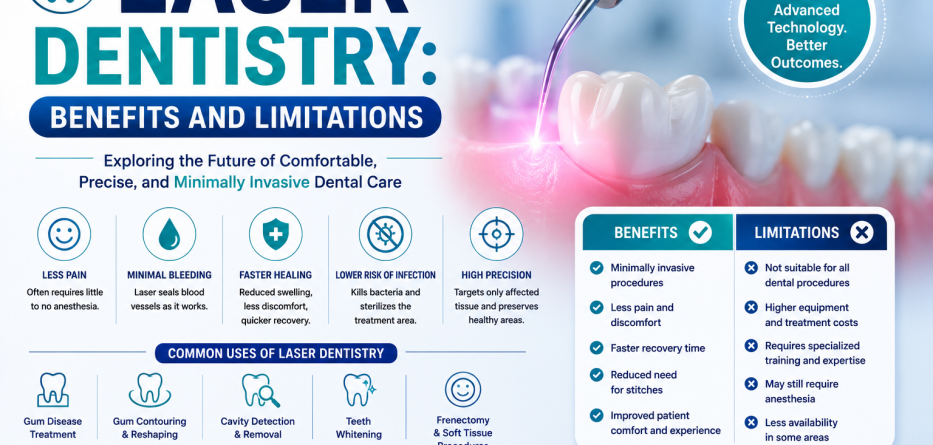
Benefits of Laser Dentistry
1. Reduced Pain and Discomfort
One of the most popular benefits of laser dentistry is increased patient comfort.
Many procedures require:
- Less drilling
- Less cutting
- Less tissue trauma
As a result, some patients may require little or no anesthesia.
2. Minimized Bleeding
Laser energy seals blood vessels as it works.
Benefits include:
- Reduced bleeding during procedures
- Cleaner surgical sites
- Improved visibility for dentists
This is especially useful during gum surgeries.
3. Faster Healing and Recovery
Laser treatment typically causes less trauma to surrounding tissues.
Patients often experience:
- Reduced swelling
- Less discomfort
- Faster recovery times
- Improved healing
This can be particularly beneficial for periodontal procedures.
4. Lower Risk of Infection
Dental lasers help sterilize the treatment area by eliminating bacteria during procedures.
This may reduce:
- Bacterial contamination
- Post-operative infections
- Inflammation
Laser therapy is commonly used in periodontal treatment for this reason.
5. Greater Precision
Lasers allow dentists to target specific tissues with exceptional accuracy.
Advantages include:
- Preservation of healthy tissue
- Better cosmetic results
- Reduced damage to surrounding structures
Precision is particularly valuable in soft tissue procedures.
6. Reduced Need for Stitches
Many laser procedures require fewer or no sutures.
Benefits include:
- Improved comfort
- Simplified healing
- Reduced post-treatment care
Patients often appreciate the convenience.
Common Uses of Laser Dentistry
Gum Disease Treatment
Lasers can remove infected tissue and bacteria while preserving healthy gum tissue.
Gum Contouring
Used to reshape uneven gum lines and improve smile aesthetics.
Cavity Detection
Some lasers help identify tooth decay in its earliest stages.
Tooth Decay Removal
Hard tissue lasers can remove decayed areas before placing fillings.
Teeth Whitening
Certain whitening procedures use lasers to activate bleaching agents.
Frenectomy
Laser treatment can correct tongue-tie or lip-tie with minimal discomfort.
Limitations of Laser Dentistry
Despite its advantages, laser dentistry is not appropriate for every situation.
1. Not Suitable for All Procedures
Traditional tools may still be necessary for:
- Large cavity preparations
- Existing metal fillings
- Certain crown procedures
- Some root canal treatments
Lasers complement rather than completely replace conventional dental instruments.
2. Equipment Costs
Dental laser systems are expensive.
This investment may result in:
- Higher treatment costs
- Limited availability
- Fewer providers offering laser procedures
Patients should discuss costs with their dentist beforehand.
3. Specialized Training Required
Laser dentistry requires additional education and certification.
Successful outcomes depend on:
- Proper training
- Clinical experience
- Appropriate case selection
Choosing a qualified provider is essential.
4. May Still Require Anesthesia
Although many laser procedures are more comfortable, anesthesia is not always eliminated.
Factors affecting anesthesia needs include:
- Procedure type
- Treatment depth
- Individual pain sensitivity
Patients should not assume all laser treatments are pain-free.
5. Limited Effectiveness on Certain Materials
Lasers cannot effectively work on the following:
- Metal fillings
- Dental crowns
- Some restorative materials
Traditional instruments remain necessary in many restorative procedures.
Laser Dentistry vs Traditional Dentistry
| Feature | Laser Dentistry | Traditional Dentistry |
|---|---|---|
| Precision | Excellent | Good |
| Bleeding | Minimal | Moderate |
| Recovery Time | Faster | Standard |
| Need for Stitches | Often Reduced | More Common |
| Patient Comfort | Higher | Variable |
| Procedure Availability | Limited | Widely Available |
| Cost | Higher | Lower |
Both approaches have important roles in modern dental care.
Is Laser Dentistry Safe?
Yes.
When performed by trained professionals, laser dentistry is considered safe and effective.
Safety measures include:
- Protective eyewear
- Controlled laser settings
- Proper training protocols
- Specialized treatment planning
Dental lasers have been used successfully for decades.
Who Is a Good Candidate for Laser Dentistry?
Laser dentistry may be ideal for patients seeking:
- Minimally invasive treatment
- Faster healing
- Reduced discomfort
- Cosmetic gum procedures
- Periodontal therapy
A consultation with a qualified dentist can determine whether laser treatment is appropriate.
Frequently Asked Questions
Is laser dentistry painful?
Most patients report less discomfort compared to traditional dental procedures.
Are dental lasers safe?
Yes. Dental lasers are considered safe when used by properly trained dental professionals.
Can lasers replace dental drills?
Not entirely. Some procedures still require conventional dental instruments.
Does laser dentistry heal faster?
In many cases, yes. Laser treatment often results in reduced swelling and faster healing.
Is laser dentistry more expensive?
Laser procedures may cost more due to specialized equipment and training requirements.
Can laser dentistry treat gum disease?
Yes. Laser therapy is commonly used to remove infected tissue and bacteria associated with periodontal disease.
Conclusion
Laser dentistry represents one of the most exciting advancements in modern dental care. By using concentrated light energy, dentists can perform many procedures with greater precision, reduced discomfort, less bleeding, and faster recovery times.
However, laser dentistry also has limitations and cannot completely replace traditional dental techniques. The best treatment approach depends on the specific procedure, patient needs, and the expertise of the dental professional.
For many patients, laser dentistry offers a comfortable and effective alternative that combines innovation, precision, and improved patient experience. Consulting with a qualified dentist can help determine whether laser-assisted treatment is the right choice for your oral health goals.

