
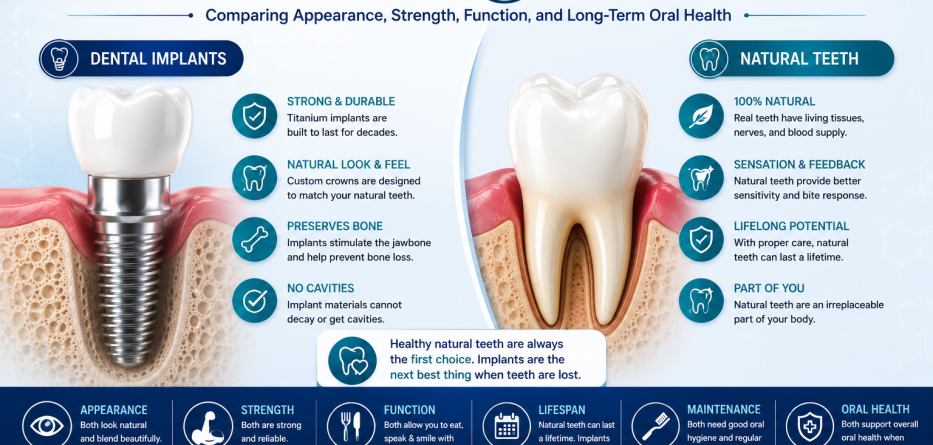
Natural teeth are designed to last a lifetime, but accidents, decay, gum disease, and aging can sometimes lead to tooth loss. When this happens, dental implants are often considered the best replacement option. However, many patients wonder: How do dental implants compare to natural teeth?
While dental implants are designed to closely mimic natural teeth in appearance and function, there are some important differences. Understanding these similarities and differences can help patients make informed decisions about tooth replacement and long-term oral health.
In this guide, we’ll compare dental implants and natural teeth based on appearance, functionality, durability, maintenance, and overall oral health benefits.
What Are Natural Teeth?
Natural teeth consist of several living structures that work together to support chewing, speaking, and smiling.
Components of a Natural Tooth
- Enamel (outer protective layer)
- Dentin
- Dental pulp (contains nerves and blood vessels)
- Tooth root
- Periodontal ligament
Natural teeth are connected to the jawbone through periodontal ligaments, which help absorb chewing forces and provide sensory feedback.
What Are Dental Implants?
Dental implants are artificial tooth replacements designed to replicate the function of natural tooth roots.
A dental implant consists of:
- Titanium implant post
- Abutment
- Dental crown
Unlike natural teeth, implants do not contain nerves or living tissue. Instead, they integrate directly with the jawbone through osseointegration.
Dental Implants vs Natural Teeth: Quick Comparison
| Feature | Natural Teeth | Dental Implants |
|---|---|---|
| Appearance | Natural | Very Natural |
| Tooth Root | Yes | Artificial Titanium Root |
| Nerves Present | Yes | No |
| Bone Stimulation | Yes | Yes |
| Can Get Cavities | Yes | No |
| Gum Disease Risk | Yes | Yes |
| Lifespan | Lifetime with Care | 20+ Years or Lifetime |
| Sensitivity | Yes | No |
| Maintenance | Brushing & Flossing | Brushing & Flossing |
Appearance: Can Dental Implants Look Like Natural Teeth?
One of the greatest advantages of dental implants is their natural appearance.
Modern implant crowns are custom-designed to match the following:
- Tooth color
- Shape
- Size
- Alignment
Winner: Tie
Most people cannot distinguish a high-quality dental implant from a natural tooth.
Functionality: Which Performs Better?
Natural teeth are biologically designed for chewing and biting.
However, dental implants can restore up to 90–95% of normal chewing function.
Benefits of Dental Implants
- Stable bite
- No slipping or movement
- Ability to eat most foods
- Comfortable speech
Advantage: Natural Teeth
Natural teeth still offer slightly superior sensory feedback because they contain nerves and periodontal ligaments.
Durability and Strength
Natural teeth are strong but can become damaged due to the following:
- Cavities
- Fractures
- Wear
- Gum disease
Dental implants are made from titanium and highly durable restorative materials.
Implant Advantages
- Cannot develop cavities
- Highly resistant to decay
- Strong chewing capability
Winner: Dental Implants
When properly maintained, implants can be more resistant to damage than natural teeth.
Sensation and Feeling
Natural teeth contain nerves that detect the following:
- Pressure
- Temperature
- Pain
Dental implants do not contain nerves.
Patients may notice:
- Reduced temperature sensitivity
- Less tactile sensation
However, most people adapt quickly and report a natural feeling after healing.
Winner: Natural Teeth
Natural teeth provide superior sensory feedback.
Bone Preservation
When a natural tooth is lost, the jawbone begins shrinking due to lack of stimulation.
Dental implants are unique because they stimulate the jawbone similarly to natural roots.
Benefits include:
- Reduced bone loss
- Preserved facial structure
- Better long-term oral health
Winner: Tie
Dental implants are the only replacement option that closely replicates this function.
Oral Hygiene Requirements
Natural Teeth
Require:
- Brushing
- Flossing
- Professional cleanings
- Cavity prevention
Dental Implants
Require:
- Brushing
- Flossing
- Regular checkups
- Prevention of peri-implant disease
Although implants cannot get cavities, surrounding gums still require proper care.
Winner: Tie
Both require consistent maintenance for long-term success.
Risk of Disease
Natural Teeth
Common risks include:
- Cavities
- Root infections
- Gum disease
Dental Implants
Common risks include:
- Peri-implant mucositis
- Peri-implantitis
- Bone loss around implants
Both require ongoing dental care.
Longevity: Which Lasts Longer?
Healthy natural teeth can last a lifetime.
Dental implants can also last decades and often remain functional for life.
Average Lifespans
| Option | Lifespan |
| Natural Teeth | Lifetime |
| Implant Post | Lifetime Potential |
| Implant Crown | 10–15 Years |
Winner: Natural Teeth
Whenever possible, preserving healthy natural teeth remains the best option.
Cost Comparison
Natural Teeth
Routine care costs:
- Cleanings
- Fillings
- Crowns
- Root canals (if necessary)
Dental Implants
Initial costs are higher because they involve:
- Surgery
- Implant placement
- Custom restoration
However, implants often provide better long-term value compared to repeated replacement treatments.
When Is a Dental Implant Better Than a Natural Tooth?
While preserving natural teeth is usually preferred, implants may become a better option when a tooth is:
- Severely decayed
- Fractured beyond repair
- Affected by advanced periodontal disease
- Causing repeated infections
In these situations, replacing a compromised tooth with a dental implant may improve long-term oral health.
Why Dentists Prefer Saving Natural Teeth First
Modern dentistry follows a conservative approach.
Most dentists will attempt to save natural teeth whenever possible through the following:
- Fillings
- Root canal therapy
- Crowns
- Periodontal treatment
Natural teeth remain the gold standard when healthy and restorable.
Advantages of Dental Implants
Key Benefits
- Natural appearance
- Excellent stability
- Bone preservation
- No cavities
- Long lifespan
- Improved chewing function
- Better speech
Advantages of Natural Teeth
Key Benefits
- Natural sensation
- Biological attachment
- Lifetime potential
- Natural aesthetics
- Superior chewing feedback
Frequently Asked Questions
Are dental implants as strong as natural teeth?
Yes. Dental implants provide excellent strength and chewing capability comparable to natural teeth.
Do dental implants feel like real teeth?
Most patients report that implants feel very similar to natural teeth after healing.
Can dental implants get cavities?
No. Implant materials cannot decay, but surrounding gum tissue can still become infected.
Which lasts longer: implants or natural teeth?
Healthy natural teeth can last a lifetime. Well-maintained implants can also remain functional for decades.
Are implants better than damaged natural teeth?
In cases of severe damage or advanced disease, implants may offer a more predictable long-term solution.
Conclusion
When comparing dental implants vs. natural teeth, it’s important to remember that natural teeth remain the ideal choice whenever they can be preserved. They provide unmatched sensation, biological function, and natural structure.
However, when tooth loss occurs, dental implants are the closest replacement available. They offer outstanding aesthetics, stability, bone preservation, and long-term durability. For many patients, dental implants provide a life-changing solution that restores both oral health and confidence.
Ultimately, the best choice depends on the condition of your natural teeth and the recommendations of your dental professional.
