
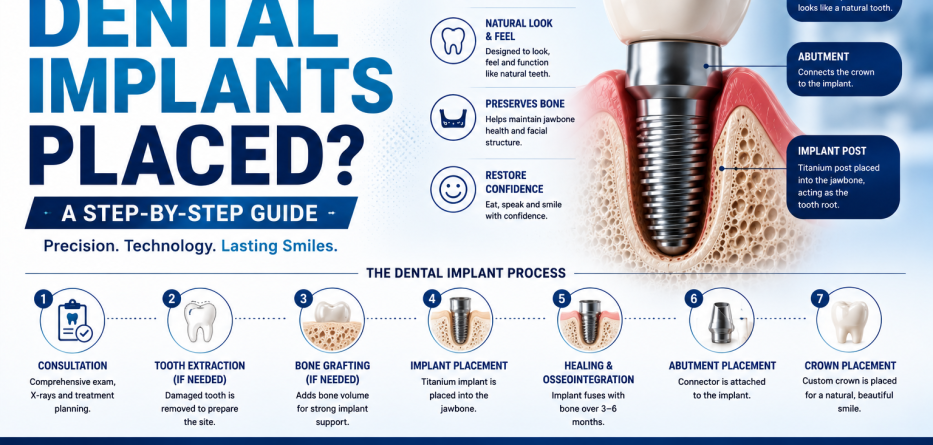
Dental implants have become one of the most effective and long-lasting solutions for replacing missing teeth. They look, feel, and function like natural teeth while helping preserve jawbone health and restore confidence. However, many patients considering treatment have one common question: How are dental implants placed?
Understanding the dental implant procedure can help reduce anxiety and prepare you for what to expect during treatment. Thanks to modern dental technology and advanced surgical techniques, implant placement is a safe and highly predictable procedure with excellent long-term success rates.
In this guide, we’ll walk you through the entire dental implant process, from the initial consultation to the final restoration.
What Is a Dental Implant?
A dental implant is a small titanium post that serves as an artificial tooth root. It is surgically placed into the jawbone and supports a replacement tooth such as a crown, bridge, or denture.
A complete dental implant consists of:
- Implant post
- Abutment
- Dental crown
Once integrated with the bone, the implant provides a stable and durable foundation for tooth replacement.
Why Are Dental Implants Placed?
Dental implants are commonly used to replace:
- A single missing tooth
- Multiple missing teeth
- An entire arch of missing teeth
Benefits include:
- Natural appearance
- Improved chewing ability
- Better speech
- Bone preservation
- Long-term durability
They are often considered the gold standard for tooth replacement.
Step 1: Initial Consultation and Evaluation
The dental implant process begins with a comprehensive examination.
Your dentist will evaluate the following:
- Oral health
- Gum condition
- Jawbone density
- Medical history
- Missing tooth area
Diagnostic Tools Used
- Digital X-rays
- Cone Beam CT (CBCT) scans
- Intraoral photographs
- Digital impressions
These tools help create a customized treatment plan.
Step 2: Treatment Planning
Once the evaluation is complete, your dentist develops a detailed implant plan.
This includes:
- Implant location
- Number of implants needed
- Bone grafting requirements
- Restoration design
- Surgical timeline
Modern digital planning allows for highly precise implant placement.
Step 3: Tooth Extraction (If Necessary)
If a damaged or failing tooth is still present, it may need to be removed before implant placement.
In some cases:
- The implant can be placed immediately after extraction.
- The site may need several weeks or months to heal first.
Your dentist will determine the best approach based on your condition.
Step 4: Bone Grafting (If Required)
Successful implants require adequate bone support.
If bone loss has occurred, a bone graft may be recommended.
Why Bone Grafting Is Needed
Bone loss may result from:
- Long-term tooth loss
- Gum disease
- Trauma
- Infection
Bone grafting helps create a strong foundation for implant placement.
Healing Time
Bone grafts typically require the following:
- 3–6 months of healing
- Bone regeneration before implant surgery
Not all patients require this step.
Step 5: Dental Implant Placement Surgery
This is the primary surgical phase of treatment.
What Happens During Surgery?
- Local anesthesia is administered.
- The dentist makes a small incision in the gum.
- A precise opening is created in the jawbone.
- The titanium implant is inserted.
- The gum tissue is closed around the implant.
The procedure is carefully planned and typically causes less discomfort than many patients expect.
How Long Does It Take?
| Procedure | Typical Time |
|---|---|
| Single Implant | 30–60 Minutes |
| Multiple Implants | 1–3 Hours |
| Full Arch Implants | Several Hours |
Step 6: Osseointegration (Healing Phase)
After placement, the implant enters the most important stage: osseointegration.
What Is Osseointegration?
Osseointegration is the process in which the jawbone bonds directly with the titanium implant.
Benefits include:
- Implant stability
- Long-term durability
- Natural tooth function
Healing Timeline
Most patients require:
- 3–6 months for complete integration
This healing phase is critical to implant success.
Step 7: Abutment Placement
Once osseointegration is complete, the dentist places an abutment.
What Is an Abutment?
The abutment is a small connector that joins the implant to the final restoration.
During this appointment:
- The gum tissue may be reopened.
- The abutment is attached.
- The area is allowed to heal for several weeks.
This creates the foundation for the crown.
Step 8: Creating the Custom Crown
After the gums heal, impressions are taken to create a custom restoration.
The dental laboratory designs a crown that matches the following:
- Tooth color
- Shape
- Size
- Bite alignment
The goal is a natural-looking result that blends seamlessly with surrounding teeth.
Step 9: Placement of the Final Restoration
The final crown is securely attached to the abutment.
Your dentist will:
- Check fit
- Verify bite alignment
- Make final adjustments
Once completed, the implant functions much like a natural tooth.
Patients can typically resume normal eating and speaking almost immediately.
Is Dental Implant Surgery Painful?
Most patients are surprised by how comfortable the procedure is.
Modern techniques include the following:
- Local anesthesia
- Sedation options
- Advanced surgical planning
Many people report that implant surgery is less uncomfortable than a tooth extraction.
Common Post-Procedure Symptoms
- Mild swelling
- Minor discomfort
- Temporary tenderness
These symptoms usually resolve within a few days.
Recovery After Dental Implant Placement
First 24 Hours
- Rest
- Use ice packs
- Avoid strenuous activity
First Week
- Eat soft foods
- Maintain oral hygiene
- Follow medication instructions
Long-Term
- Attend follow-up appointments
- Maintain excellent oral hygiene
- Avoid smoking
Proper care promotes successful healing.
How Long Does the Entire Process Take?
The timeline varies depending on individual needs.
| Stage | Approximate Duration |
|---|---|
| Consultation | 1 Visit |
| Extraction (If Needed) | 1 Visit |
| Bone Grafting (If Needed) | 3–6 Months |
| Implant Placement | 1 Visit |
| Osseointegration | 3–6 Months |
| Crown Placement | 1–2 Visits |
Total treatment time may range from 3 to 12 months.
Success Rates of Dental Implants
Dental implants are among the most successful procedures in modern dentistry.
Average Success Rates
- Single implants: 95–98%
- Multiple implants: 95%+
- Full-arch implants: 90–98%
Proper planning, healthy bone support, and good oral hygiene contribute to these excellent outcomes.
Frequently Asked Questions
How long does implant surgery take?
A single implant typically takes 30–60 minutes to place.
Do dental implants require surgery?
Yes. Implant placement involves a minor surgical procedure performed under local anesthesia.
How long does healing take?
Osseointegration generally takes 3–6 months.
Can implants be placed immediately after extraction?
In some cases, yes. This depends on bone quality and the condition of the extraction site.
How successful are dental implants?
Success rates commonly exceed 95% when treatment is performed correctly and maintained properly.
Conclusion
Understanding how dental implants are placed can help patients feel more confident about the treatment process. From the initial consultation and treatment planning to implant placement, healing, and final restoration, every step is carefully designed to ensure long-term success.
With modern technology, advanced materials, and proven surgical techniques, dental implants provide a reliable solution for restoring missing teeth. For many patients, the result is a stronger bite, improved oral health, and a natural-looking smile that can last for decades.
