Dental implants are one of the most reliable and long-lasting solutions for replacing missing teeth. However, successful implant placement depends on several factors, and one of the most important is having enough healthy jawbone to support the implant.
Many patients considering dental implants worry that they may not have sufficient bone due to tooth loss, gum disease, or aging. Fortunately, modern implant dentistry offers solutions even for individuals with reduced bone volume.
In this guide, we’ll explain how much bone is typically needed for dental implants, how dentists evaluate bone levels, what happens if bone is insufficient, and the treatment options available to help patients qualify for implant therapy.
Why Is Bone Important for Dental Implants?
Dental implants function as artificial tooth roots. To remain stable, the implant must be securely anchored within the jawbone.
The bone provides:
- Primary implant stability
- Long-term support
- Successful osseointegration
- Resistance to chewing forces
- Protection against implant failure
Without adequate bone, the implant may not integrate properly and could become unstable over time.
How Much Bone Is Needed for a Dental Implant?
The amount of bone required depends on the following:
- Implant size
- Implant location
- Bone density
- Type of restoration
- Patient-specific anatomy
General Guidelines
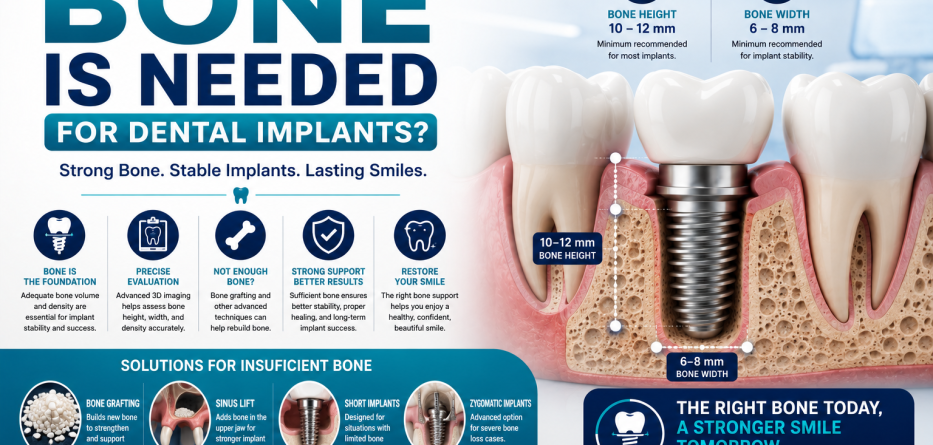
For a standard dental implant, dentists often look for:
| Bone Requirement | Typical Measurement |
|---|---|
| Bone Width | 6–8 mm |
| Bone Height | 10–12 mm |
| Bone Density | Moderate to High |
These measurements may vary depending on the implant system and treatment plan.
Bone Requirements for Different Areas of the Mouth
Front Teeth
Front teeth generally experience lower chewing forces and may require less bone than molars.
Typical considerations include the following:
- Adequate bone width
- Strong aesthetic support
- Healthy gum tissue
Premolars
Premolar implants often require moderate bone volume and density.
Requirements vary depending on:
- Bite forces
- Tooth size
- Available space
Molars
Molars experience the greatest chewing pressure.
As a result, they often require:
- Greater bone width
- Increased stability
- Stronger bone support
How Dentists Measure Bone for Implants
Modern implant planning relies on advanced imaging technology.
Clinical Examination
The dentist evaluates:
- Gum health
- Existing bone contours
- Oral health status
Digital X-Rays
Provide an initial view of:
- Bone height
- Tooth roots
- Adjacent structures
Cone Beam CT (CBCT) Scans
CBCT imaging is considered the gold standard for implant planning.
It provides detailed information about:
- Bone width
- Bone height
- Bone density
- Nerve location
- Sinus position
This allows highly accurate treatment planning.
What Causes Bone Loss in the Jaw?
Several factors can reduce jawbone volume.
Tooth Loss
When a tooth is missing, the jawbone no longer receives stimulation from chewing forces.
Bone loss can begin within months after extraction.
Gum Disease
Periodontal disease is one of the leading causes of bone destruction around teeth.
Trauma
Injuries to the mouth can result in bone loss or structural damage.
Denture Use
Long-term denture wear may contribute to jawbone resorption over time.
Medical Conditions
Certain health conditions can affect bone density and quality.
What Happens If There Isn’t Enough Bone?
Insufficient bone does not automatically disqualify a patient from receiving dental implants.
However, inadequate bone may increase the risk of:
- Implant instability
- Implant failure
- Poor osseointegration
- Functional limitations
Fortunately, several treatment options can rebuild or enhance bone volume.
Bone Grafting for Dental Implants
Bone grafting is one of the most common solutions for patients with insufficient bone.
What Is Bone Grafting?
Bone grafting involves adding bone material to areas where bone volume is lacking.
The graft acts as a scaffold that encourages new bone growth.
Benefits
- Increases bone volume
- Improves implant stability
- Enhances long-term success
- Expands treatment options
Healing typically takes several months before implant placement.
Sinus Lift Procedures
For implants in the upper back jaw, bone height may be limited by the sinus cavity.
A sinus lift creates additional space by
- Elevating the sinus membrane
- Adding bone graft material
- Increasing implant support
This procedure is commonly performed before upper molar implants.
Short Dental Implants
Advances in implant technology have introduced shorter implant designs.
These implants may be suitable when:
- Bone height is limited
- Bone grafting is not preferred
- Anatomical structures restrict placement
Short implants can often provide excellent outcomes when properly planned.
Zygomatic Implants
For severe upper jaw bone loss, zygomatic implants may be considered.
These specialized implants anchor into the cheekbone rather than the jawbone.
Benefits include:
- Avoiding extensive grafting
- Supporting full-arch restorations
- Treating severe bone loss cases
Does Bone Density Matter?
Yes.
Bone quality is just as important as bone quantity.
Strong Bone Density Provides
- Better implant stability
- Faster healing
- Improved osseointegration
- Higher long-term success rates
The dentist evaluates both volume and density during treatment planning.
How to Maintain Healthy Jawbone for Implants
Replace Missing Teeth Early
Prompt treatment helps prevent bone resorption.
Maintain Good Oral Hygiene
Healthy gums support healthy bone.
Attend Regular Dental Visits
Routine monitoring helps identify problems early.
Avoid Smoking
Smoking negatively affects bone health and healing.
Eat a Bone-Healthy Diet
Important nutrients include:
- Calcium
- Vitamin D
- Protein
- Magnesium
Good nutrition supports strong bone structure.
Frequently Asked Questions
Can I get dental implants if I’ve had missing teeth for years?
Possibly. Even with significant bone loss, treatments such as bone grafting can often make implants possible.
How do dentists determine if I have enough bone?
Dentists use clinical exams, X-rays, and CBCT scans to evaluate bone volume and density.
Does everyone need a bone graft before implants?
No. Many patients have sufficient bone and can proceed directly with implant placement.
How long does bone grafting take to heal?
Healing typically takes between 3 and 9 months, depending on the procedure and individual circumstances.
Can bone grow back naturally after tooth loss?
Bone regeneration is limited without stimulation. Dental implants help preserve existing bone by mimicking natural tooth roots.
Conclusion
Adequate jawbone support is one of the most important factors in successful dental implant treatment. While most standard implants require sufficient bone width, height, and density, modern dentistry offers numerous solutions for patients with reduced bone volume.
Through advanced imaging, bone grafting, sinus lift procedures, and innovative implant designs, many individuals who were once considered poor candidates can now enjoy the benefits of dental implants.
If you’re considering implants, a comprehensive evaluation by an experienced implant dentist can determine whether you have enough bone and what treatment options are available to help restore your smile.