
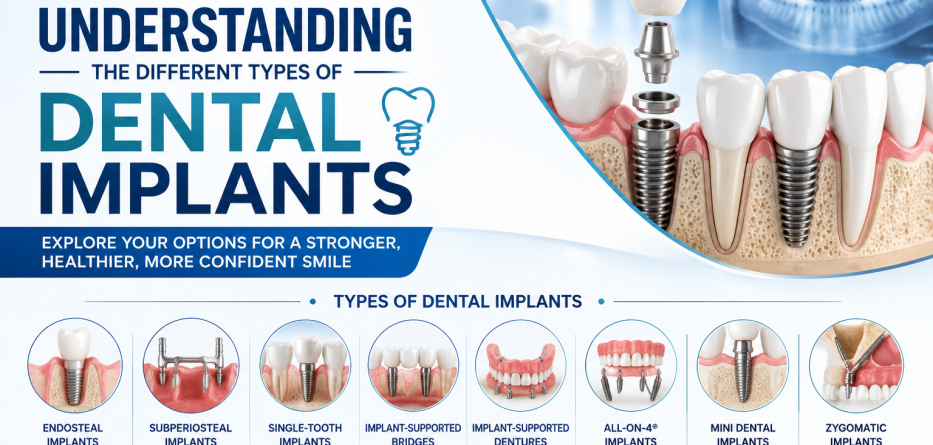
Dental implants have revolutionized modern dentistry by providing a durable, natural-looking solution for missing teeth. Whether you’re missing a single tooth or an entire arch, dental implants can restore both function and confidence.
However, many patients are surprised to learn that there isn’t just one type of dental implant. Different implant systems are designed to address specific dental needs, bone conditions, and treatment goals.
In this guide, you’ll learn about the various types of dental implants, how they work, their advantages, and which option may be best for your situation.
What Are Dental Implants?
Dental implants are artificial tooth roots, typically made of titanium or zirconia, that are surgically placed into the jawbone. Once integrated with the bone through a process called osseointegration, they provide a stable foundation for replacement teeth.
Main Components of a Dental Implant
- Implant Post
- Abutment
- Dental Crown, Bridge, or Denture
Why Understanding Implant Types Matters
Not all patients have the same oral health needs. Factors such as bone density, the number of missing teeth, and overall health influence which implant type is most suitable.
Choosing the right implant can:
- Improve treatment success
- Enhance comfort and appearance
- Reduce treatment time
- Maximize long-term durability
1. Endosteal Dental Implants
What Are Endosteal Implants?
Endosteal implants are the most common type of dental implant used today. They are surgically placed directly into the jawbone and act as artificial tooth roots.
Best For
- Patients with healthy jawbone density
- Single tooth replacement
- Multiple missing teeth
- Full-arch restorations
Advantages
- High success rate
- Long-lasting results
- Excellent stability
- Natural appearance
Potential Drawbacks
- Requires sufficient bone volume
- May require bone grafting if bone loss exists
2. Subperiosteal Dental Implants
What Are Subperiosteal Implants?
Subperiosteal implants sit on top of the jawbone but beneath the gum tissue rather than being inserted into the bone.
Best For
- Patients with insufficient jawbone
- Individuals who cannot undergo bone grafting
Advantages
- Less invasive than some grafting procedures
- Alternative for patients with severe bone loss
Limitations
- Less commonly used today
- Lower long-term stability compared to endosteal implants
3. Single-Tooth Dental Implants
When only one tooth is missing, a single implant can replace it without affecting neighboring teeth.
Benefits
- Preserves healthy adjacent teeth
- Prevents bone loss
- Looks and functions like a natural tooth
Ideal Candidates
Patients missing one tooth due to:
- Trauma
- Decay
- Failed root canal treatment
4. Implant-Supported Bridges
What Is an Implant-Supported Bridge?
Instead of replacing every missing tooth with an individual implant, a bridge is anchored using dental implants.
Benefits
- Replaces multiple missing teeth
- Fewer implants required
- Cost-effective solution
Best For
Patients missing several adjacent teeth.
5. Implant-Supported Dentures
Traditional dentures can sometimes slip while eating or speaking.
Implant-supported dentures attach securely to implants for greater stability.
Advantages
- Improved chewing ability
- Better speech
- Increased comfort
- Reduced movement
Types
Removable Implant Dentures
Can be removed for cleaning.
Fixed Implant Dentures
Permanently attached by a dentist.
6. All-on-4 Dental Implants
What Is All-on-4?
The All-on-4 technique uses four strategically placed implants to support a full arch of replacement teeth.
Benefits
- Full smile restoration
- Faster treatment
- Reduced need for bone grafting
- Fixed, non-removable teeth
Best For
Patients with significant tooth loss or failing dentition.
7. All-on-6 Dental Implants
Similar to All-on-4, this approach uses six implants to support a full arch.
Advantages
- Enhanced stability
- Better load distribution
- Increased long-term durability
Recommended For
Patients with adequate jawbone volume seeking maximum support.
8. Zygomatic Dental Implants
What Are Zygomatic Implants?
Zygomatic implants are anchored into the cheekbone rather than the upper jaw.
Best For
Patients with severe upper jaw bone loss.
Benefits
- Often eliminates the need for bone grafting
- Provides support in challenging cases
Important Note
This procedure requires a highly experienced implant specialist.
9. Mini Dental Implants
Mini implants are smaller in diameter than traditional implants.
Advantages
- Less invasive procedure
- Faster healing
- Lower cost
Common Uses
- Stabilizing dentures
- Small tooth replacement areas
Limitations
May not be suitable for all full-function restorations.
Titanium vs Zirconia Dental Implants
| Feature | Titanium | Zirconia |
|---|---|---|
| Track Record | Excellent | Growing |
| Strength | High | High |
| Biocompatibility | Excellent | Excellent |
| Metal-Free | No | Yes |
| Aesthetics | Very Good | Excellent |
Titanium Implants
Most commonly used and extensively researched.
Zirconia Implants
Popular among patients seeking a metal-free alternative.
How to Choose the Right Type of Dental Implant
The best implant depends on:
- Number of missing teeth
- Jawbone density
- Gum health
- Budget
- Cosmetic goals
- Medical history
A comprehensive dental evaluation is essential before selecting a treatment option.
Which Dental Implant Type Is Most Popular?
Endosteal implants remain the most widely used dental implant type due to their reliability, durability, and high success rates.
For full-mouth restoration, All-on-4 and All-on-6 systems have become increasingly popular because they provide life-changing results with fewer implants.
Conclusion
Understanding the different types of dental implants is the first step toward choosing the best solution for your smile. From traditional endosteal implants to advanced full-arch systems like All-on-4 and specialized zygomatic implants, modern dentistry offers options for nearly every patient.
Consulting an experienced implant dentist can help determine which treatment provides the best combination of function, aesthetics, and long-term success for your unique needs.
