

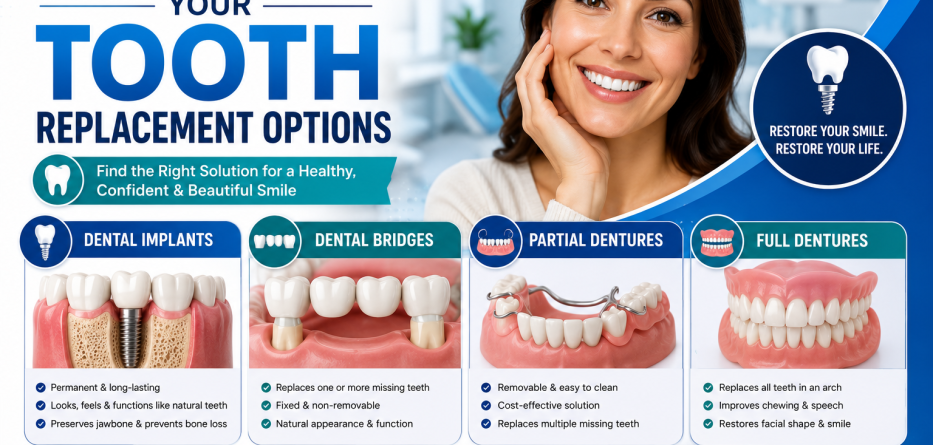
Missing teeth can affect much more than your appearance. They can impact your ability to chew, speak clearly, maintain proper oral health, and feel confident in your smile. Fortunately, modern dentistry offers several effective tooth replacement options designed to restore both function and aesthetics.
Whether you’ve lost a single tooth, multiple teeth, or an entire arch, understanding your available treatment choices is the first step toward making an informed decision. Each solution comes with its own benefits, costs, longevity, and maintenance requirements.
In this guide, we’ll explore the most common tooth replacement options, compare their advantages and disadvantages, and help you determine which solution may be best for your needs.
Why Replacing Missing Teeth Is Important
Many people assume that losing a tooth is primarily a cosmetic concern. However, untreated tooth loss can lead to several oral health problems.
Potential Consequences of Missing Teeth
- Bone loss in the jaw
- Shifting of neighboring teeth
- Bite misalignment
- Difficulty chewing food
- Speech challenges
- Increased risk of gum disease
- Premature facial aging
Replacing missing teeth helps preserve your oral health and overall quality of life.
Common Tooth Replacement Options
Modern dentistry offers four primary tooth replacement solutions:
- Dental Implants
- Dental Bridges
- Partial Dentures
- Full Dentures
Each option serves different needs depending on the number of missing teeth, oral health condition, and budget.
Dental Implants
What Are Dental Implants?
Dental implants are titanium posts surgically placed into the jawbone to act as artificial tooth roots. Once integrated with the bone, they support crowns, bridges, or dentures.
Advantages of Dental Implants
- Natural appearance
- Exceptional stability
- Prevent bone loss
- Long-lasting solution
- Preserve neighboring teeth
- Comfortable and secure
Considerations
- Higher initial investment
- Requires minor surgery
- Healing period of several months
Best For
- Single missing teeth
- Multiple missing teeth
- Full-mouth restoration
- Patients with healthy bone structure
Dental implants are often considered the gold standard in tooth replacement due to their durability and ability to preserve jawbone health.
Dental Bridges
What Is a Dental Bridge?
A dental bridge replaces one or more missing teeth by using neighboring teeth as anchors for an artificial tooth.
Advantages
- Faster treatment
- Lower initial cost
- Natural appearance
- Non-removable solution
Considerations
- Requires alteration of healthy adjacent teeth
- Does not prevent bone loss
- May require replacement after several years
Best For
- One or two missing teeth
- Patients who are not candidates for implants
Partial Dentures
What Are Partial Dentures?
Partial dentures are removable appliances used to replace several missing teeth while preserving remaining natural teeth.
Advantages
- Affordable option
- Non-surgical treatment
- Quick fabrication
- Easy to replace multiple teeth
Considerations
- May shift while eating
- Requires daily removal and cleaning
- Less stable than implants
Best For
- Multiple missing teeth
- Budget-conscious patients
Full Dentures
What Are Complete Dentures?
Full dentures replace an entire upper or lower arch of missing teeth.
Advantages
- Cost-effective solution
- Restores appearance
- Improves speech and chewing ability
Considerations
- Can become loose over time
- May require adhesives
- Bone loss continues beneath dentures
Best For
- Patients missing all teeth in one or both arches
Implant-Supported Dentures
An increasingly popular alternative combines the benefits of implants and dentures.
How They Work
Several implants are placed in the jawbone to support a removable or fixed denture.
Benefits
- Improved stability
- Enhanced chewing power
- Reduced slipping
- Better comfort
- Bone preservation
Ideal For
Patients seeking a more secure alternative to traditional dentures.
Comparing Tooth Replacement Options
| Feature | Dental Implants | Bridges | Partial Dentures | Full Dentures |
|---|---|---|---|---|
| Bone Preservation | Yes | No | No | No |
| Stability | Excellent | Good | Moderate | Moderate |
| Appearance | Excellent | Excellent | Good | Good |
| Longevity | 20+ Years | 5-15 Years | 5-10 Years | 5-10 Years |
| Removable | No | No | Yes | Yes |
| Surgery Required | Yes | No | No | No |
Factors to Consider When Choosing a Tooth Replacement Option
Selecting the right solution depends on several factors.
Number of Missing Teeth
Single tooth loss may be best addressed with an implant or bridge, while multiple missing teeth may require dentures or implant-supported restorations.
Jawbone Health
Patients with sufficient bone density often qualify for implants.
Budget
Treatment costs vary significantly between options.
Lifestyle Preferences
Some patients prefer fixed restorations, while others are comfortable with removable appliances.
Long-Term Goals
Consider durability, maintenance requirements, and overall value over time.
Which Tooth Replacement Option Lasts the Longest?
Dental implants generally offer the greatest longevity.
Average Lifespans
| Treatment | Average Lifespan |
| Dental Implants | 20+ Years |
| Dental Bridges | 5-15 Years |
| Partial Dentures | 5-10 Years |
| Full Dentures | 5-10 Years |
With proper care, implant posts can often last a lifetime.
Maintaining Your Tooth Replacement
Regardless of the option you choose, proper maintenance is essential.
Care Tips
- Brush twice daily
- Floss regularly
- Visit your dentist every six months
- Avoid smoking
- Follow professional cleaning recommendations
Good oral hygiene helps extend the lifespan of restorations and protect overall oral health.
Frequently Asked Questions
What is the best replacement for a missing tooth?
Dental implants are often considered the most effective and long-lasting solution for replacing missing teeth.
Are dental implants better than dentures?
For many patients, yes. Implants offer greater stability, comfort, and bone preservation.
Can I replace multiple missing teeth with implants?
Yes. Implants can support single crowns, bridges, or full-arch restorations.
Are bridges cheaper than implants?
Bridges typically have a lower initial cost, but implants may offer better long-term value.
How do I know which option is right for me?
A comprehensive dental evaluation can help determine the best treatment based on your oral health, budget, and goals.
Conclusion
Understanding your tooth replacement options is essential when restoring your smile and oral health. Dental implants, bridges, partial dentures, and full dentures each offer unique advantages depending on your individual needs.
While dental implants provide the most natural function, stability, and longevity, other options may be suitable based on factors such as budget, bone health, and personal preferences. Consulting with an experienced dental professional can help you choose the solution that best supports your long-term oral health and quality of life.
Replacing missing teeth not only improves your smile but also protects your jawbone, supports proper chewing function, and enhances overall confidence.

