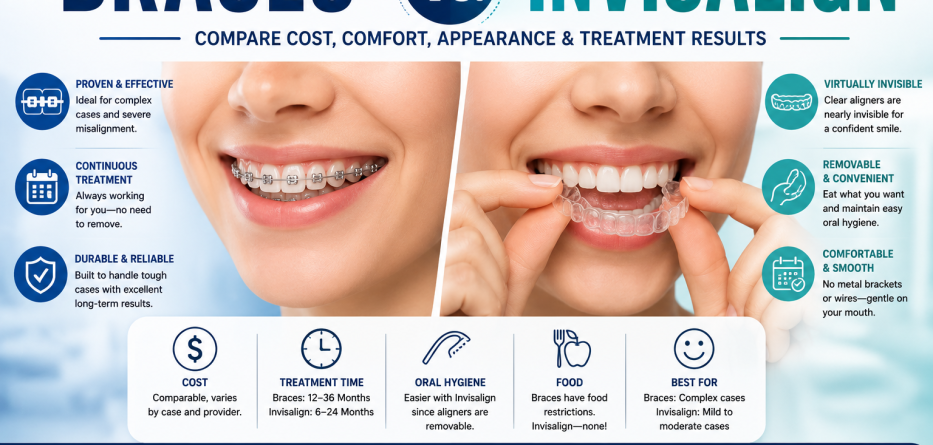
A straight, healthy smile can boost confidence, improve oral health, and make daily activities like chewing and speaking easier. If you’re considering orthodontic treatment, you’ve likely come across two of the most popular options available today: traditional braces and Invisalign clear aligners.
Both treatments are designed to correct crooked teeth, bite problems, spacing issues, and other orthodontic concerns. However, they differ significantly in appearance, comfort, treatment time, maintenance, and cost.
Understanding the differences between braces and Invisalign can help you choose the treatment that best fits your lifestyle, budget, and orthodontic needs.
In this guide, we’ll compare braces vs. Invisalign, discuss their advantages and disadvantages, and help you determine which option may be right for your smile.
What Are Traditional Braces?
Traditional braces use metal or ceramic brackets attached to the teeth and connected by wires.
The orthodontist periodically adjusts the wires to gradually move teeth into their proper positions.
Components of Braces
- Brackets
- Archwires
- Elastic bands (when needed)
Braces have been used successfully for decades and remain one of the most effective orthodontic treatments available.
What Is Invisalign?
Invisalign is a modern orthodontic system that uses a series of clear, removable aligners to straighten teeth.
Each aligner is custom-made using digital technology and gradually shifts teeth into alignment.
How Invisalign Works
- Digital scan of your teeth
- Customized treatment plan
- Series of clear aligners
- Aligner changes every 1–2 weeks
- Regular progress evaluations
The aligners are virtually invisible, making them a popular choice among adults and teens.
Braces vs. Invisalign: Quick Comparison
| Feature | Braces | Invisalign |
|---|---|---|
| Appearance | Visible | Nearly Invisible |
| Removability | Fixed | Removable |
| Comfort | Moderate | Generally More Comfortable |
| Food Restrictions | Yes | Minimal |
| Oral Hygiene | More Difficult | Easier |
| Treatment Time | 12–36 Months | 6–24 Months |
| Complex Cases | Excellent | Moderate to Advanced |
| Cost | Moderate | Moderate to Higher |
Appearance: Which Is More Discreet?
Braces
Traditional braces are visible when smiling or speaking.
Modern options include the following:
- Metal braces
- Ceramic braces
- Tooth-colored brackets
Although ceramic braces are less noticeable, they are still visible.
Invisalign
Invisalign aligners are made from transparent plastic.
Benefits include:
- Virtually invisible appearance
- Greater confidence during treatment
- Professional appearance for adults
Winner: Invisalign
For patients concerned about aesthetics, Invisalign offers a much more discreet treatment option.
Comfort Comparison
Braces
Braces may cause:
- Wire irritation
- Bracket discomfort
- Soreness after adjustments
Orthodontic wax is often used to reduce irritation.
Invisalign
Invisalign aligners are:
- Smooth
- Custom-fitted
- Free from metal components
Patients often experience less irritation than with traditional braces.
Winner: Invisalign
Most patients find Invisalign more comfortable.
Effectiveness: Which Works Better?
Braces
Braces are extremely effective for:
- Severe crowding
- Significant bite problems
- Rotated teeth
- Complex orthodontic cases
Because braces are fixed, they work continuously.
Invisalign
Invisalign can effectively treat:
- Mild crowding
- Moderate spacing issues
- Many bite problems
- Cosmetic alignment concerns
However, complex cases may still benefit from braces.
Winner: Depends on the Case
Braces generally offer more versatility for severe orthodontic issues.
Treatment Time
Braces
Average treatment duration:
- 12 to 36 months
Complex cases may require longer treatment.
Invisalign
Average treatment duration:
- 6 to 24 months
Treatment speed depends heavily on patient compliance.
Winner: Invisalign (In Many Cases)
Some patients achieve results faster with Invisalign.
Oral Hygiene and Maintenance
Braces
Brushing and flossing around brackets can be challenging.
Patients may require:
- Interdental brushes
- Water flossers
- Additional cleaning tools
Invisalign
Aligners can be removed for:
- Brushing
- Flossing
- Eating
This allows easier oral hygiene maintenance.
Winner: Invisalign
Maintaining oral hygiene is generally easier.
Eating and Dietary Restrictions
Braces
Certain foods should be avoided, including:
- Popcorn
- Hard candy
- Nuts
- Sticky foods
- Chewing gum
These foods can damage brackets and wires.
Invisalign
Aligners are removed before meals.
Patients can continue enjoying most foods without restrictions.
Winner: Invisalign
Greater dietary freedom.
Compliance Requirements
Braces
Because braces are fixed, they work continuously regardless of patient behavior.
Invisalign
Aligners must be worn:
- 20–22 hours per day
Failure to wear aligners consistently can delay results.
Winner: Braces
Braces eliminate the risk of non-compliance.
Cost Comparison
Costs vary based on complexity and location.
Braces
Generally range from the following:
- Moderate cost
- Often covered by orthodontic benefits
Invisalign
Often similar to or slightly higher than braces.
Factors affecting cost include:
- Number of aligners
- Treatment complexity
- Provider experience
Winner: Varies
Costs are increasingly comparable.
Advantages of Braces
Pros
- Effective for complex cases
- Continuous treatment
- No patient compliance concerns
- Proven long-term results
Cons
- More visible
- Food restrictions
- More difficult cleaning
- Potential discomfort
Advantages of Invisalign
Pros
- Nearly invisible
- Removable
- Comfortable
- Easier oral hygiene
- No food restrictions
Cons
- Requires discipline
- Not ideal for every case
- Aligners can be misplaced
- May cost slightly more
Who Should Choose Braces?
Braces may be best for patients who:
- Have severe orthodontic issues
- Need significant bite correction
- Prefer a fixed treatment option
- May struggle with aligner compliance
Who Should Choose Invisalign?
Invisalign may be ideal for patients who:
- Want a discreet treatment
- Prioritize comfort
- Have mild to moderate alignment issues
- Can commit to wearing aligners consistently
Frequently Asked Questions
Is Invisalign faster than braces?
In some cases, Invisalign can produce results faster, but treatment duration depends on the complexity of the case.
Are braces more effective than Invisalign?
For severe orthodontic issues, braces are often more effective. Invisalign is highly effective for many mild to moderate cases.
Which is more painful?
Both treatments can cause temporary discomfort, but Invisalign is generally considered more comfortable.
Can teenagers use Invisalign?
Yes. Invisalign offers specialized options designed for teenagers.
Which treatment is more affordable?
Costs vary, but braces and Invisalign are often similarly priced.
Can Invisalign fix bite problems?
Many bite issues can be corrected with Invisalign, although severe cases may require braces.
Conclusion
When comparing braces vs. Invisalign, there is no universal winner. Both treatments can effectively straighten teeth and improve oral health.
Traditional braces remain the best choice for many complex orthodontic cases and provide reliable, continuous treatment. Invisalign offers a more discreet, comfortable, and convenient solution for patients seeking a modern approach to teeth straightening.
The best option depends on your orthodontic needs, lifestyle, budget, and treatment goals. A consultation with an experienced orthodontist can help determine which solution will deliver the best results for your smile.