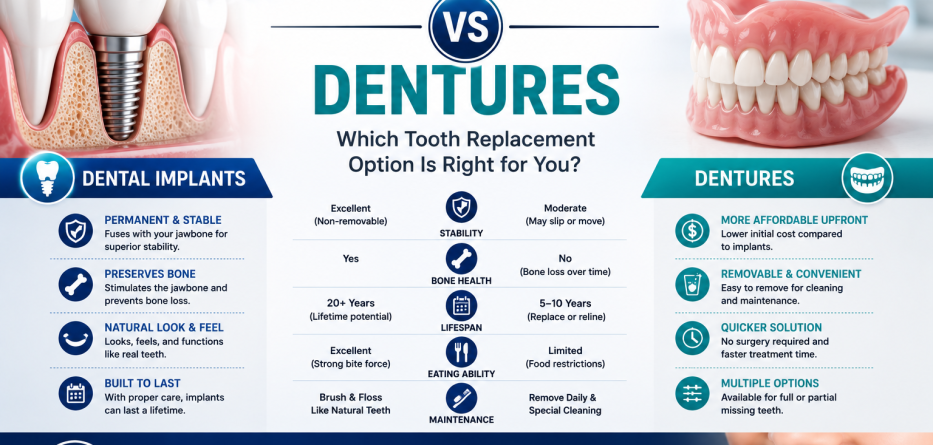
If you’re missing one or more teeth, you’ve likely come across two of the most common tooth replacement options: dental implants and dentures. Both treatments can restore your smile, improve chewing ability, and boost confidence. However, they differ significantly in terms of comfort, appearance, maintenance, longevity, and cost.
Choosing between dental implants and dentures is an important decision that can affect your oral health and quality of life for years to come. Understanding the advantages and limitations of each option can help you determine which solution best meets your needs.
In this guide, we’ll compare dental implants and dentures side by side, covering everything from functionality and appearance to cost and long-term benefits.
What Are Dental Implants?
Dental implants are artificial tooth roots made from titanium that are surgically placed into the jawbone. Once they fuse with the bone through a process called osseointegration, they support a crown, bridge, or implant-supported denture.
Key Features of Dental Implants
- Permanent tooth replacement solution
- Mimic natural tooth roots
- Preserve jawbone health
- Highly durable and stable
- Natural appearance and function
Many dentists consider implants the gold standard for replacing missing teeth.
What Are Dentures?
Dentures are removable appliances designed to replace missing teeth and surrounding tissues.
There are two primary types:
Complete Dentures
Used when all teeth are missing in the upper or lower arch.
Partial Dentures
Used when some natural teeth remain.
Dentures rest on the gums and are removable for cleaning and maintenance.
Dental Implants vs Dentures: Quick Comparison
| Feature | Dental Implants | Dentures |
|---|---|---|
| Stability | Excellent | Moderate |
| Appearance | Very Natural | Natural |
| Bone Preservation | Yes | No |
| Comfort | Excellent | Moderate |
| Lifespan | 20+ Years | 5–10 Years |
| Maintenance | Similar to Natural Teeth | Daily Removal Required |
| Eating Ability | Excellent | Limited |
| Speech Improvement | Excellent | Moderate |
| Initial Cost | Higher | Lower |
| Long-Term Value | Excellent | Moderate |
Appearance: Which Looks More Natural?
Dental Implants
Dental implants are designed to look and feel like natural teeth.
Benefits include:
- Customized color matching
- Natural tooth contours
- No visible metal components
- Seamless integration with existing teeth
Many people cannot distinguish implants from natural teeth.
Dentures
Modern dentures can also provide a pleasing appearance.
However, over time, bone loss may cause dentures to become loose or alter facial appearance.
Winner: Dental Implants
Implants generally provide the most natural-looking and natural-feeling result.
Comfort and Stability
Dental Implants
Because implants fuse directly with the jawbone, they remain securely in place.
Advantages:
- No slipping
- No clicking sounds
- No movement while eating
- Greater confidence
Dentures
Dentures may shift during:
- Eating
- Speaking
- Laughing
Some patients require adhesives to improve stability.
Winner: Dental Implants
Implants offer superior comfort and stability.
Eating and Chewing Performance
One of the biggest concerns for patients is eating ability.
Dental Implants
Implants restore chewing power similar to natural teeth.
Patients can comfortably enjoy:
- Steak
- Apples
- Nuts
- Corn on the cob
- Crunchy vegetables
Dentures
Dentures may limit the ability to eat hard or sticky foods.
Common challenges include:
- Reduced bite force
- Food restrictions
- Denture movement
Winner: Dental Implants
Implants provide significantly better chewing efficiency.
Impact on Jawbone Health
Dental Implants
Implants stimulate the jawbone just like natural tooth roots.
Benefits include:
- Bone preservation
- Reduced bone loss
- Improved facial support
Dentures
Dentures sit on top of the gums and do not stimulate the jawbone.
Over time, this can lead to:
- Bone shrinkage
- Facial sagging
- Poor denture fit
Winner: Dental Implants
This is one of the most important advantages of implants.
Longevity and Durability
Dental Implants
With proper care:
- Implant posts can last a lifetime
- Crowns often last 10–15 years or more
Dentures
Most dentures require replacement or relining every 5–10 years due to wear and changes in the jawbone.
Winner: Dental Implants
Implants generally offer a much longer lifespan.
Maintenance Requirements
Dental Implants
Care is similar to natural teeth:
- Brush twice daily
- Floss regularly
- Routine dental visits
Dentures
Require:
- Daily removal
- Special cleaning solutions
- Overnight soaking
- Additional maintenance
Winner: Dental Implants
Implants provide a more convenient long-term solution.
Cost Comparison
Dental Implants
Higher initial investment due to:
- Surgical placement
- Implant components
- Advanced planning
Dentures
Lower upfront cost, making them more accessible for many patients.
However, ongoing adjustments and replacements can add long-term expenses.
Winner: Depends on Budget
Dentures cost less initially, while implants often provide greater long-term value.
Who Is a Good Candidate for Dental Implants?
Ideal implant candidates typically have:
- Healthy gums
- Adequate jawbone density
- Good oral hygiene habits
- Stable overall health
Bone grafting may help patients with insufficient bone qualify for treatment.
Who Is a Good Candidate for Dentures?
Dentures may be suitable for patients who:
- Have extensive tooth loss
- Prefer a non-surgical option
- Have limited bone support
- Need a lower-cost solution
Dentures remain a reliable option for many individuals.
Implant-Supported Dentures: The Best of Both Worlds?
Implant-supported dentures combine the advantages of both treatments.
Benefits include:
- Increased stability
- Reduced slipping
- Improved chewing ability
- Better comfort
- Bone preservation
Many patients choose this option when replacing a full arch of teeth.
Pros and Cons Summary
Dental Implants Pros
- Natural appearance
- Superior stability
- Bone preservation
- Long lifespan
- Better chewing ability
Dental Implants Cons
- Higher initial cost
- Surgical procedure required
- Longer treatment timeline
Denture Pros
- Lower upfront cost
- Non-surgical solution
- Faster treatment
Denture Cons
- Bone loss over time
- Potential slipping
- Reduced chewing efficiency
- More maintenance
Frequently Asked Questions
Are dental implants better than dentures?
For many patients, yes. Implants offer greater stability, comfort, bone preservation, and longevity.
Do dentures look as natural as implants?
Modern dentures look natural, but implants generally provide the most realistic appearance and feel.
Which option lasts longer?
Dental implants typically last much longer than dentures.
Are implants more expensive?
Yes, implants usually require a higher upfront investment, but they often provide better long-term value.
Can dentures be converted to implants later?
In many cases, yes. Patients may transition to implant-supported solutions after evaluation.
Conclusion
When comparing dental implants and dentures, both options can successfully restore missing teeth and improve quality of life. However, dental implants generally provide superior stability, comfort, appearance, and long-term oral health benefits.
Dentures remain an effective and affordable solution, especially for patients seeking a non-surgical or lower-cost option. Ultimately, the best choice depends on your oral health, budget, lifestyle, and treatment goals.
Consulting with an experienced dental professional can help determine whether dental implants, dentures, or implant-supported dentures are the right solution for your smile.